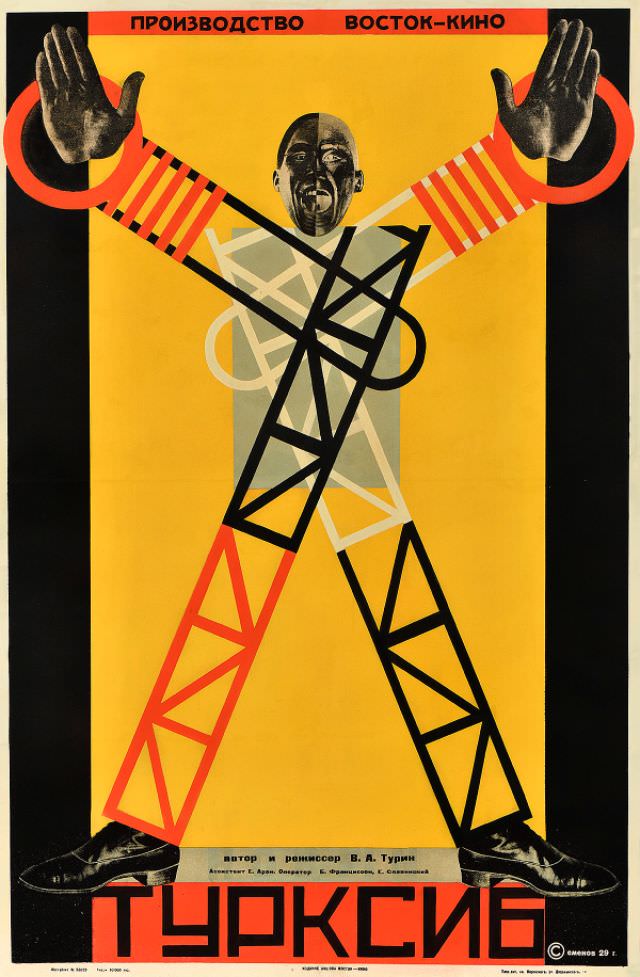
Bold Soviet-era graphic design dominates this poster for *Turksib* (1929), directed by Viktor Turin, where a monumental human figure is built from stark, intersecting beams like a living piece of industrial scaffolding. The palette of warm yellow with sharp red and black accents, plus the oversized hands raised high, creates the sense of a public announcement—urgent, modern, and meant to be read from across a street. Cyrillic lettering and the “Vostok-Kino” credit anchor it firmly in early cinema’s world of studios, slogans, and striking visual shorthand.
Across the figure’s torso, angled trusses and looping lines suggest rails, bridges, and the engineered pathways of a new age, turning the body itself into infrastructure. That visual metaphor fits the film’s reputation as an industrial documentary, aligning human labor with machinery and motion, and inviting viewers to imagine the landscape reshaped by transport and construction. Even without a literal train pictured, the composition feels kinetic—diagonals push the eye downward to polished shoes and back up to the commanding gesture, like a surge of momentum.
For collectors and film historians, images like this offer more than nostalgic appeal: they’re a window into how 1920s Soviet movie posters sold ideas as much as entertainment. *Turksib* remains a key title in discussions of documentary filmmaking, propaganda aesthetics, and avant-garde poster art, and this design is a vivid example of that intersection. Whether you’re searching for “Turksib 1929 poster,” “Viktor Turin film,” or “Soviet cinema art,” this piece embodies the era’s belief that modernity could be drawn in clean lines and loud colors.