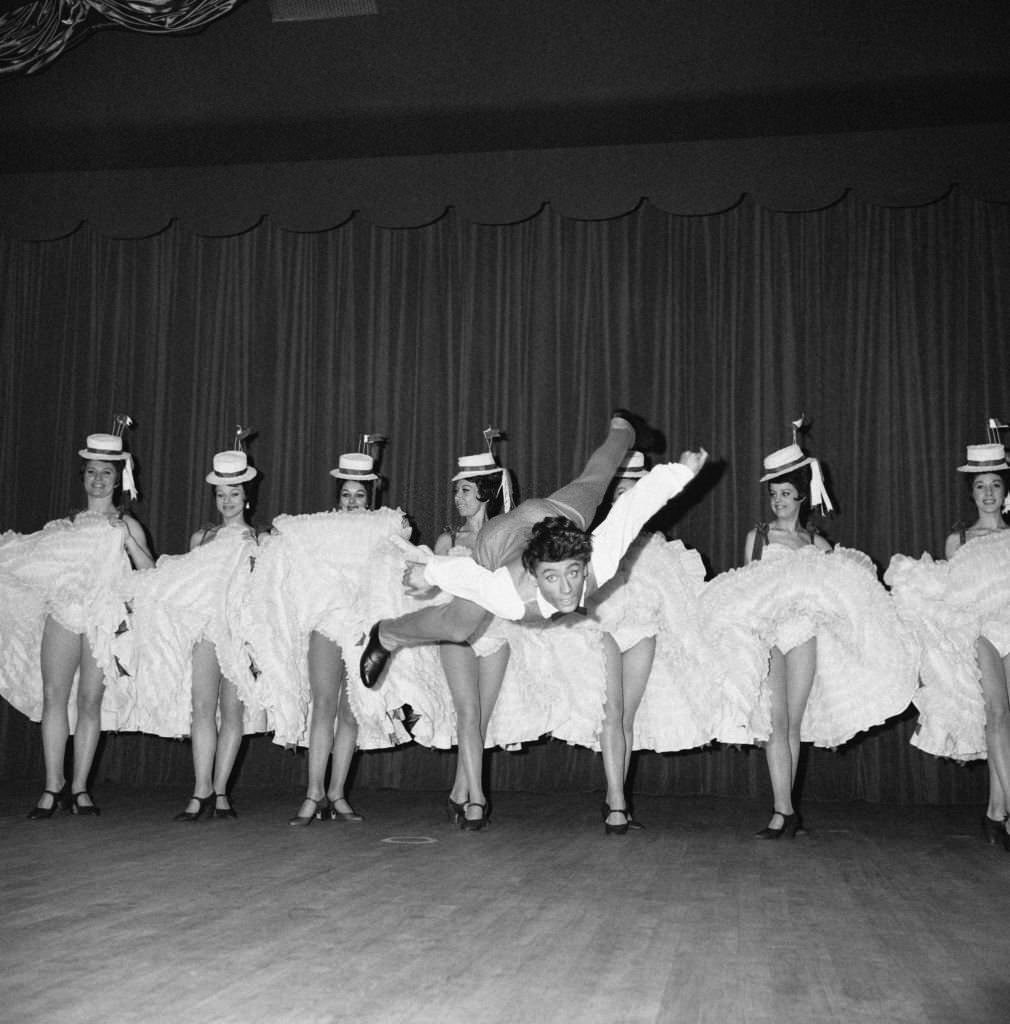
Mid-leap at center stage, star dancer Jean-Pierre Charnas freezes in a daring, horizontal pose, arms flung wide as if he’s flying straight out into the audience. Behind him, a chorus line of cancan dancers forms a bright, ruffled wall of skirts and legs, their smiles and symmetry amplifying the stunt’s comic bravura. The tall theater curtain and open floor keep the focus on movement—clean, bold, and unmistakably made for spectacle.
Feathered boater hats and cascading petticoats signal the classic Moulin Rouge look, yet the staging feels brisk and modern for the era, blending precision with playful exaggeration. The dancers hold their positions like a living frame, letting the eye snap to Charnas’s airborne body and polished shoes. Even in stillness, the photograph suggests the snap of music cues, the swish of fabric, and the disciplined athleticism that powered mid-century Paris cabaret.
Taken in 1964 during the new revue “Frou-frou” at the Moulin Rouge in Paris, the image offers a vivid window into the cancan’s 20th-century reinvention as both tradition and show-business machine. It’s a moment of fashion and culture as much as dance history: costumes engineered for impact, choreography built on endurance, and a star turn designed to read instantly from the back row. For anyone searching classic Moulin Rouge cancan photos, Paris nightlife, or vintage revue performance, this frame distills the glamour, humor, and physical demand of the stage into one unforgettable beat.