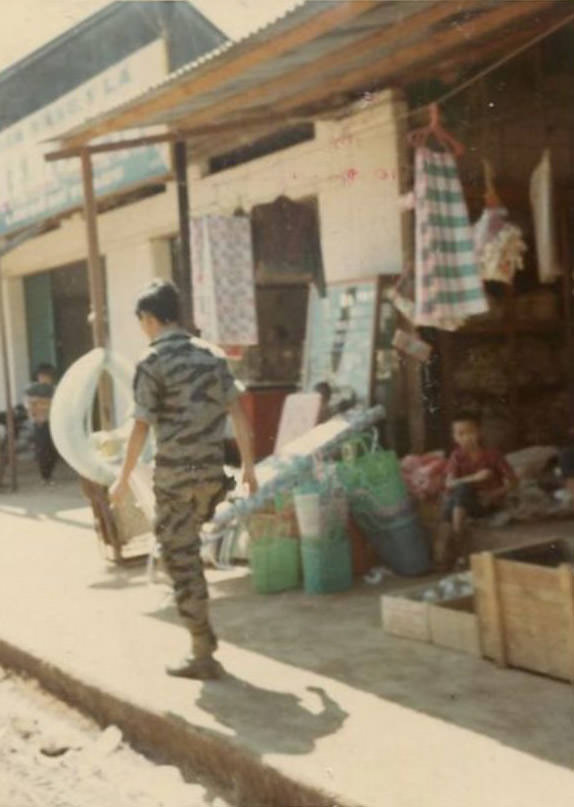
A lone ARVN soldier moves along a sunlit street in Bồng Sơn, his camouflage blending into the dusty palette of a wartime town that still has errands to run and goods to sell. The scene is in color, soft and slightly faded, and that gentleness makes the everyday details feel immediate—boots on pavement, a casual stride, the quiet presence of armed service amid ordinary commerce. As Vietnam War images go, it leans less on spectacle and more on the way conflict coexisted with routine.
Under the shop’s shallow awning, bundles of textiles hang beside stacks of plastic containers and household items set out at the curb, suggesting a storefront serving neighbors as much as passersby. A person sits close to the entrance in the shade, while the soldier passes without ceremony, neither posing nor performing for the camera. The contrast between bright midday light and the darker interior frames the storefront like a small stage where civilian life continues despite uncertainty.
Bồng Sơn appears here not as a battlefield but as a lived-in place, where an unidentified South Vietnamese Army soldier becomes part of the street’s normal traffic. For readers searching Vietnam War history, ARVN perspectives, or glimpses of South Vietnamese city life, this photograph offers a grounded view of how military presence threaded through markets and sidewalks. Its anonymity—no names, no precise moment pinned down—invites reflection on the countless unrecorded days that made up the war’s long middle.