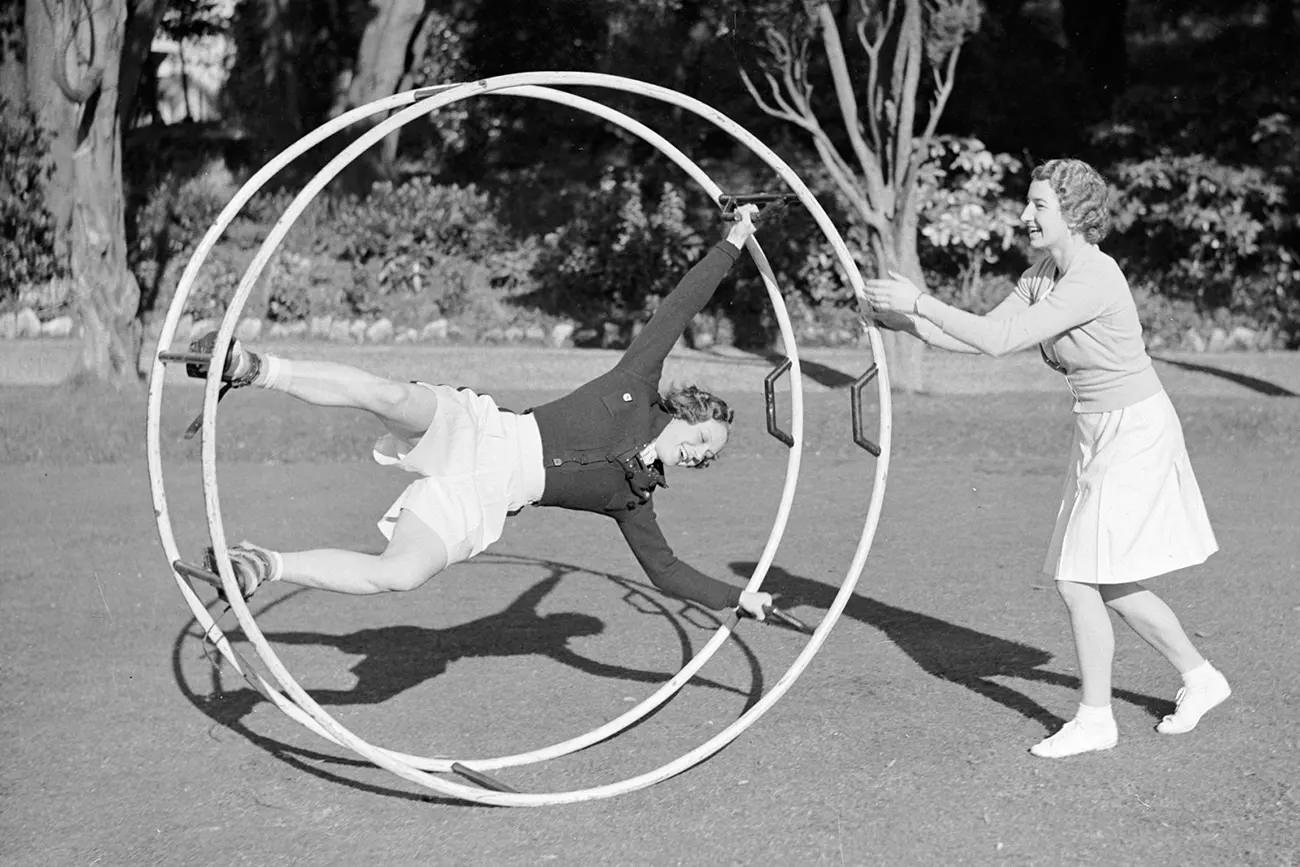
Few fitness fads look as delightfully impractical as the “human hamster wheel” pictured here, dated to 1936. Out on a grassy lawn, one woman stretches her body across a giant circular frame, gripping handles as the wheel rolls beneath her; another stands beside it, smiling as she steadies or nudges the contraption along. The scene feels part sport, part spectacle—an outdoor workout that turns balance, strength, and sheer nerve into entertainment.
The apparatus itself is a striking piece of exercise engineering: an oversized ring with multiple rails and handholds meant to keep the rider suspended as momentum carries the wheel forward. Instead of the controlled repetitions of modern gym machines, this method demands full-body engagement—core bracing, shoulder stability, and coordinated leg drive—while the moving circle threatens to pitch the athlete off balance at any moment. Even in a still photograph, the sense of motion comes through in the long shadows and the poised, mid-roll posture.
As a historical photo, it fits neatly into the broader story of weird exercise machines and workout methods from the past, when “scientific” fitness often blurred into novelty. The 1930s fascination with physical culture encouraged inventive gadgets that promised health, agility, and modernity, sometimes more for their showmanship than their practicality. For anyone searching for vintage sports history, early fitness equipment, or unusual workout trends, this human hamster wheel offers a memorable glimpse of how earlier generations played with the idea of progress in exercise.