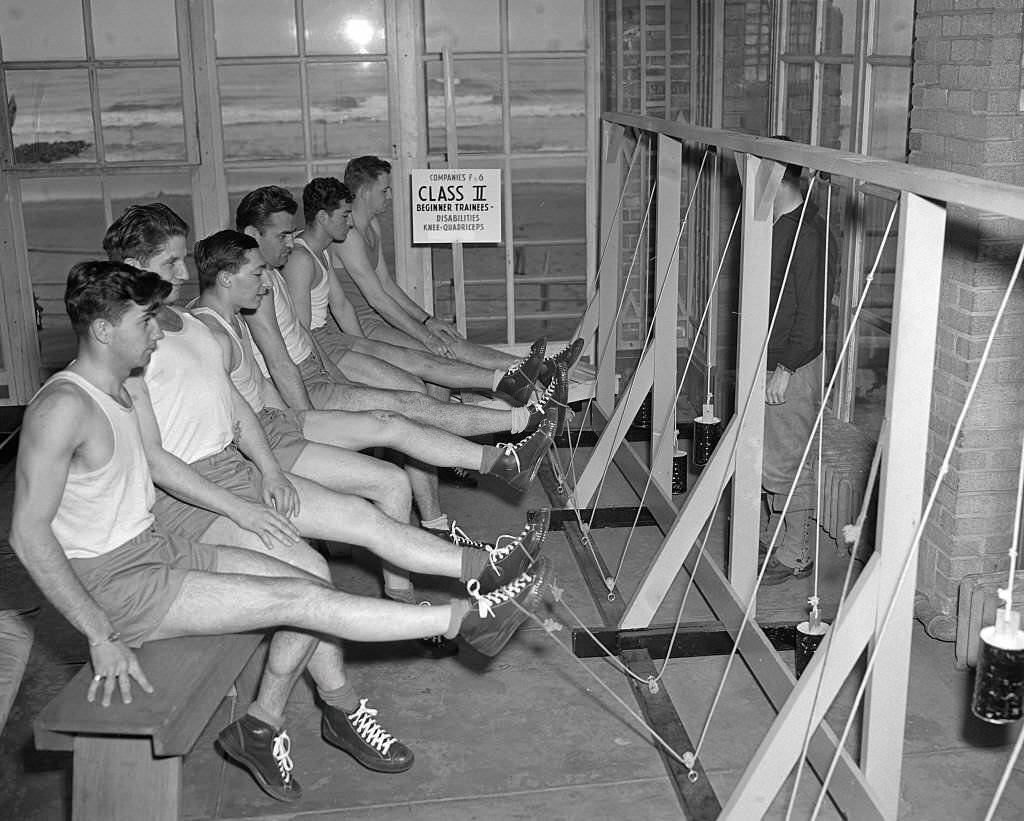
Rows of young American soldiers sit on narrow benches inside a bright hospital ward, lifting their legs in unison as cables and pulleys tug back against their boots. The apparatus looks like an early, oversized cousin of today’s gym machines—part rehabilitation tool, part endurance test—designed to rebuild strength through repeated, measured motion. Framed by tall windows and a utilitarian interior, the scene has the orderly feel of a clinic where recovery is treated as a daily drill.
A small sign in the room points to “Class II” and mentions “beginning trainees” along with “disabilities,” hinting that these men are not simply working out for sport but training their bodies back to function after injury or illness. Each lift is synchronized, as if the discipline of military life has been carried straight into physical therapy, with the machine setting the tempo and the group providing momentum. Even without dramatic action, the photograph conveys the quiet intensity of rehab: persistence, repetition, and the hope of returning to full duty.
Unusual exercise machines and forgotten workout methods often seem strange at first glance, yet they reveal how seriously earlier generations approached conditioning and medical recovery. This historical photo of hospital-based leg strengthening offers a rare look at early physical therapy for soldiers, where mechanics and medicine meet in a practical, no-nonsense setup. For readers interested in vintage fitness, military history, or the evolution of rehabilitation equipment, it’s a compelling reminder that behind every invention was a human need to walk, work, and live normally again.