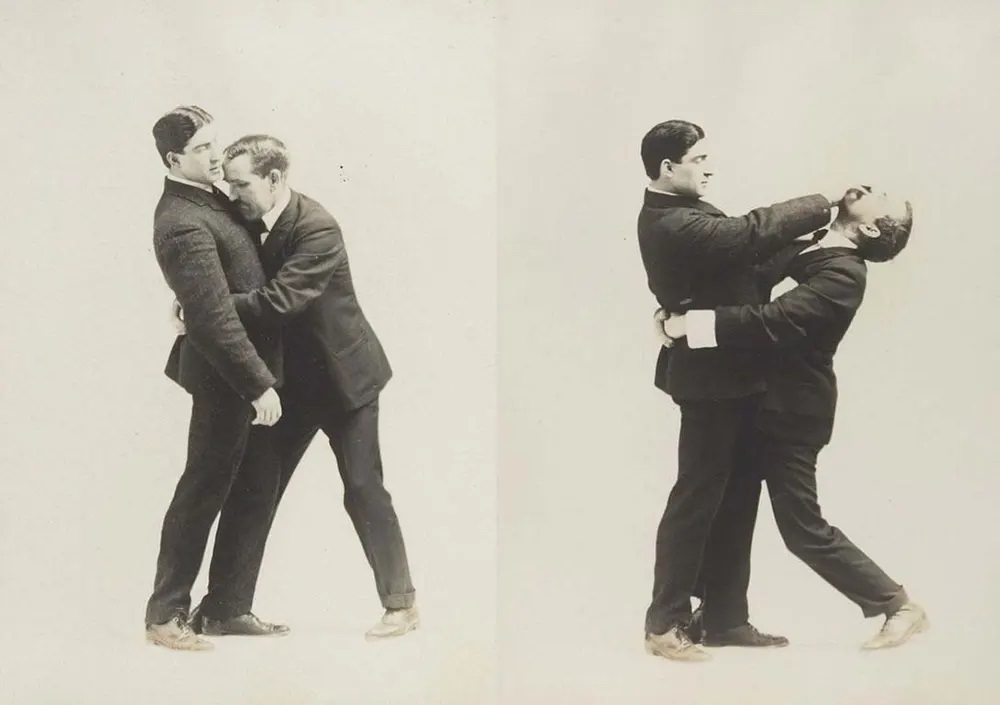
Victorian ideas of “sport” often blurred into practical instruction, and this 1895 self-defense guide page makes that intersection wonderfully clear. Two suited men demonstrate close-quarters maneuvers with the formality of a studio lesson, their stiff collars and polished shoes contrasting with the intimate grappling positions. The plain background keeps attention on posture, leverage, and hand placement—exactly what an early martial-arts or boxing manual wanted readers to study.
On the left, the pair are locked chest-to-shoulder, one figure stepping in as if to smother movement while the other braces and counters, weight distributed through a forward stance. At right, the sequence shifts to a more dramatic control: a firm hold at the torso paired with an arm extended toward the head and face, presenting a moment of dominance and balance disruption. Even without captions visible here, the photographs read like step-by-step demonstrations meant to be copied, practiced, and perfected.
Beyond the technique, the image is a small window into late-19th-century anxieties and aspirations—personal safety, urban crowds, and the belief that disciplined training could tame sudden violence. For collectors of antique sports ephemera, early self-defense manuals, or Victorian photography, it’s an evocative example of how instructional images were staged before modern action photography. It also speaks to the era’s fascination with codifying the body: turning instinctive reactions into “maneuvers” that could be taught on the printed page.