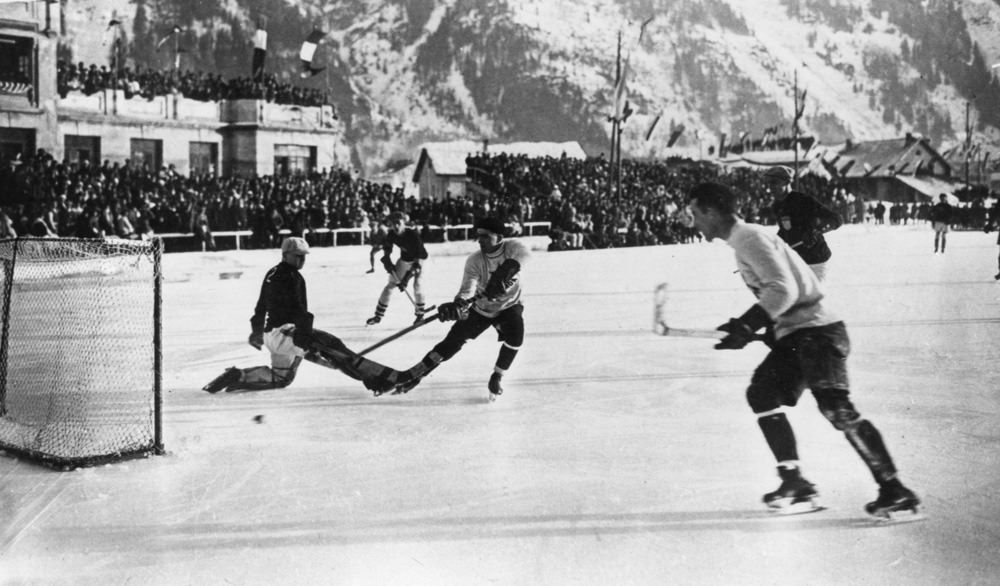
Under the shadow of the Chamonix mountains, a goalmouth scramble unfolds on open ice as Canada’s Toronto Granites drive the play in the Olympic final against the United States. The net sits exposed at the left edge of the frame, the goaltender dropping low while skaters surge in with sticks extended and skates cutting shallow arcs across the surface. Behind the boards, a dense crowd presses in, turning the rink into a packed amphitheater where every rush would have rippled through the stands.
What makes the scene so vivid is its early-era feel: minimal protective gear, heavy sweaters, and a game played in broad daylight with the Alps as a backdrop. Flags hang above the spectators, anchoring the moment to the international pageantry of the first Winter Olympics in Chamonix, France. The composition emphasizes speed and tension—one attacker closing, another arriving late, defenders chasing the play as the puck is forced toward the crease.
The title’s result—Toronto’s 6–1 win for Olympic gold on Feb. 3, 1924—turns this snapshot into a key artifact in ice hockey history and Canada’s early Olympic legacy. It’s a reminder that the sport’s biggest stages once looked like community rinks scaled up for the world, where geography, weather, and crowd energy were as much a part of the contest as tactics. For readers searching Olympic hockey history, Chamonix 1924, or the Toronto Granites, this photo offers a crisp window into the origins of winter sports spectacle.