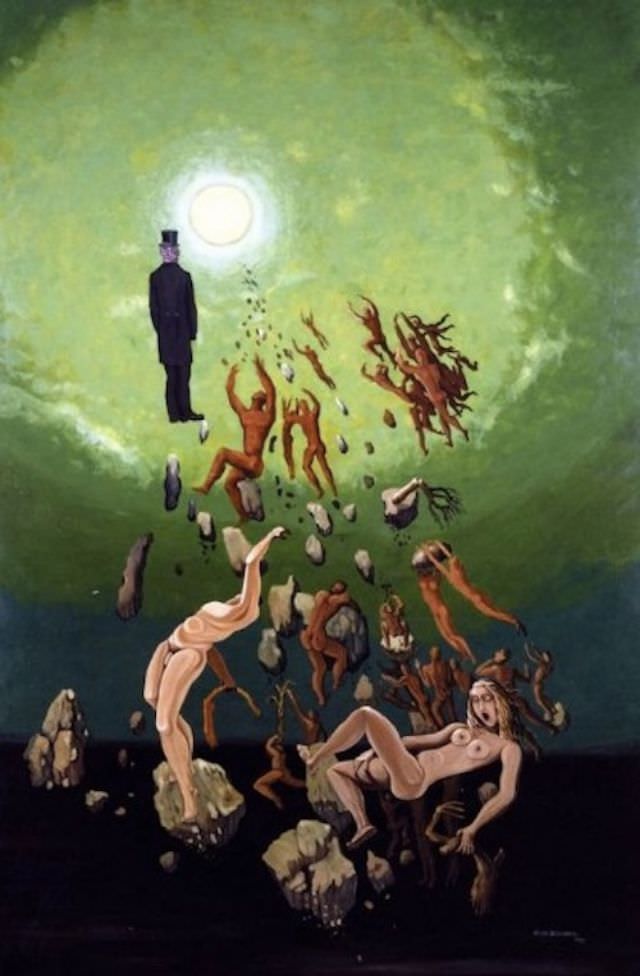
Suspended in a green, swirling void, a solitary figure in a dark suit and top hat drifts near a bright, sunlike disc, as if measuring the edge between ordinary life and a more volatile realm. Below him, bodies tumble and twist through space—some nude, some rendered in warmer reds and browns—caught in a slow-motion fall that feels both weightless and catastrophic. Scattered rocks float among them like debris from a shattered world, turning the scene into a dream of gravity undone.
The title, “The Reappearance of Hypergenesis, 1932,” invites a reading shaped by interwar anxieties and avant-garde imagination, where “reappearance” suggests a return of forces thought buried or conquered. The stark contrast between the formally dressed observer and the chaotic human forms amplifies themes of detachment, spectacle, and the uneasy role of modernity as witness to upheaval. Light concentrates near the top, while the lower space darkens into deep blues and blacks, a visual descent that echoes mythic falls and psychological disintegration.
Art lovers searching for surrealist-style imagery, symbolic 1930s art, or historical modernist works will find this composition rich with interpretive hooks: metamorphosis, collapse, and the strange calm of a lone onlooker. Its painterly atmosphere and theatrical arrangement make it ideal for a WordPress feature that explores how artists used fantastical scenes to speak about real-world uncertainty. Whether read as allegory, prophecy, or pure dream logic, the work lingers in the mind—an unsettling tableau of humanity adrift.