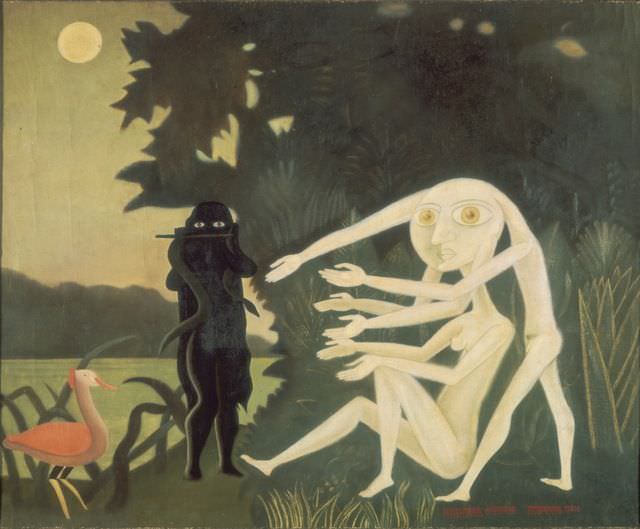
Moonlight hangs over a quiet stretch of water, turning the shoreline into a stage for something half dream, half fable. On one side, a small pink bird—resembling a flamingo—stands near the reeds, its bright body punctuating the muted greens and smoky shadows. The background feels humid and thick with foliage, as if the night air itself has weight, while the pale disc of the moon keeps watch from above.
At the center of “The Encounter, 1946,” two uncanny figures meet in a charged stillness: a dark, slender silhouette with glowing eyes faces a pale, long-limbed being whose wide gaze seems fixed and searching. Their bodies are simplified almost to symbols, yet the tension between them is immediate—curiosity, caution, and invitation all implied by the outstretched hands. The surrounding plants and deep shadow shapes frame the moment like a curtain, suggesting a boundary between the familiar world and whatever lies beyond it.
Postwar art often leaned into allegory and the subconscious, and this artwork’s surreal atmosphere fits that mood without needing a specific narrative spelled out. The contrast of light and dark, the theatrical poses, and the strange calm of the landscape make it an evocative piece for readers interested in 1940s modern art, surrealism, and symbolic storytelling. As a WordPress feature image, it rewards close looking: every shape—the moon, the reeds, the bird, the staring eyes—adds another layer to the encounter.