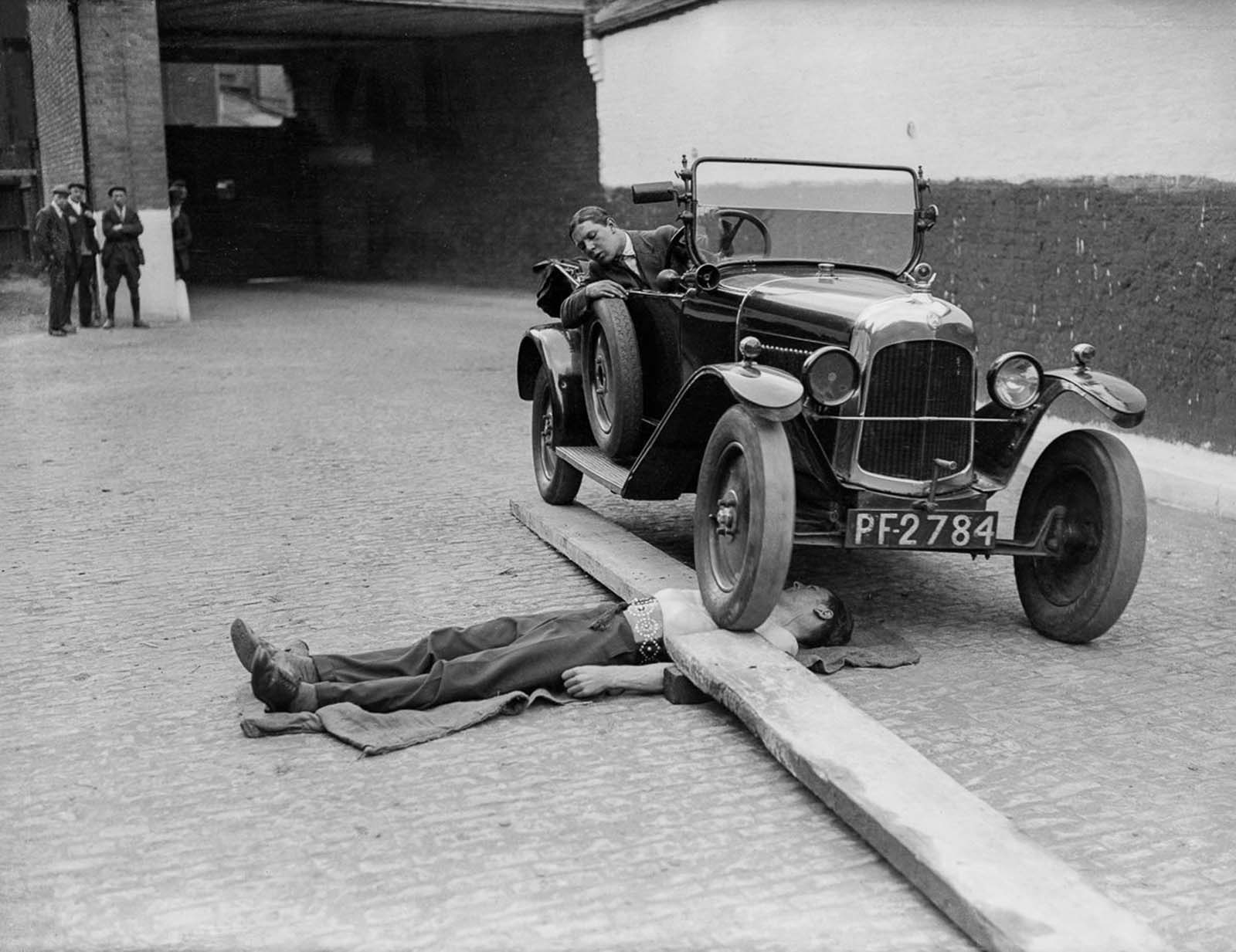
Against a stark street and warehouse-like backdrop, strongman J. Rolleano lies flat on blankets while a Citroën is carefully positioned above him, its front wheel resting where his chest meets the ground. A long timber acts as a ramp and guide, turning a terrifying stunt into a controlled demonstration, while a suited man leans from the car as if monitoring the exact placement. The tension of the moment is heightened by the small group of onlookers at the edge of the scene, held at a distance yet clearly drawn in by the spectacle.
Staged feats of strength like this were a hallmark of early 20th-century popular entertainment, when “human endurance” acts competed for attention alongside the era’s growing fascination with automobiles and modern machinery. Rolleano’s performance turns the car from a symbol of progress into a literal weight to be borne, blending athletic showmanship with the danger that made such exhibitions headline-worthy. Even without hearing the crowd, the photograph conveys the careful choreography required for a stunt that depended on precision as much as power.
For historians of sport and performance, the 1932 image offers more than shock value: it captures a moment when publicity, technology, and physical culture met in the public street. Details like the period Citroën’s grille, the visible license plate, and the improvised ramp underscore how these demonstrations were grounded in everyday urban spaces, not just circus rings. As a piece of vintage sports history, it invites readers to consider what audiences demanded from their heroes—and what performers were willing to risk to deliver it.