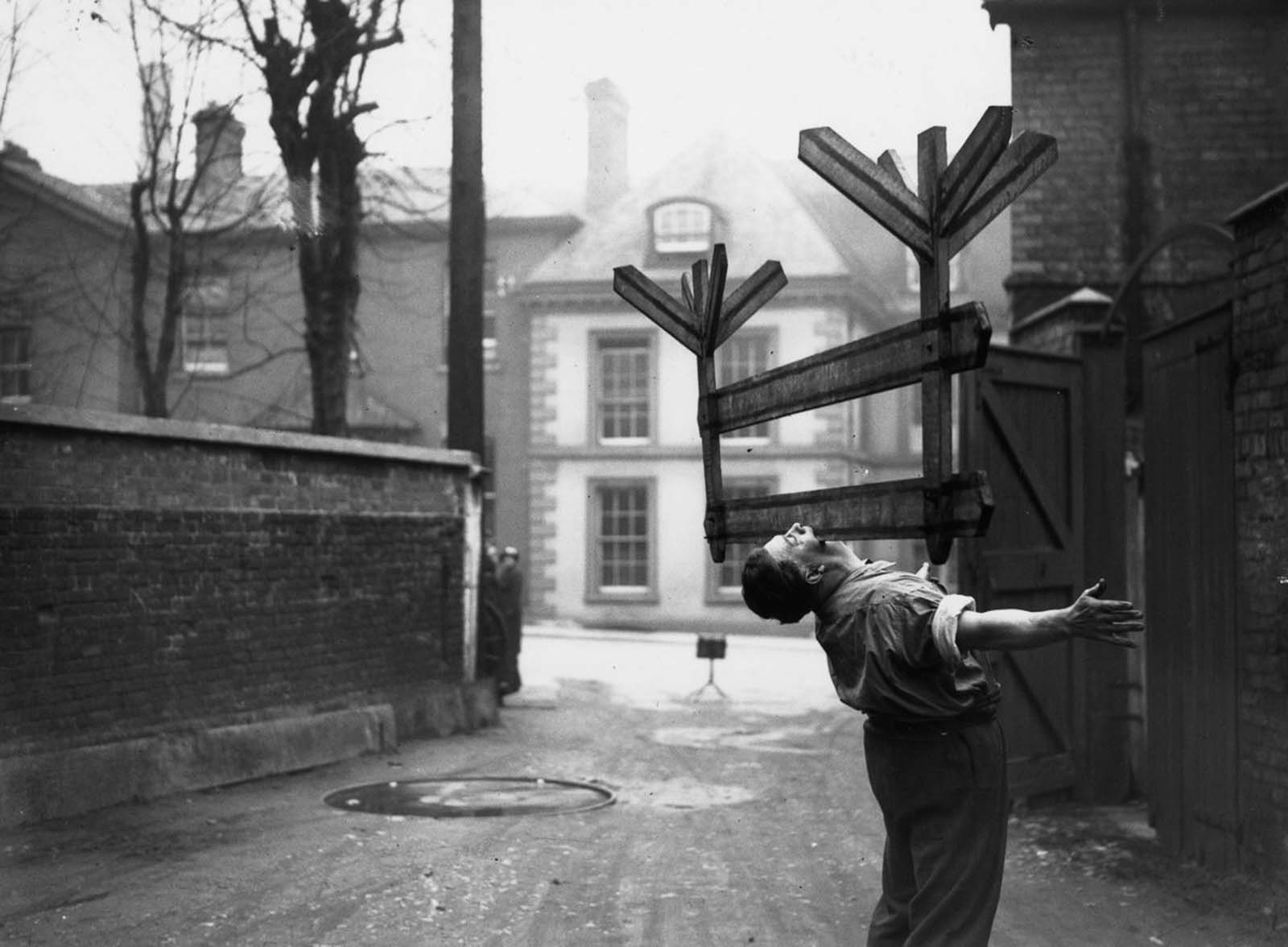
Balanced on nothing but a clenched jaw, a hefty wooden roadworks notice juts out like a miniature scaffold as Joe Smith leans back and holds his body rigid, arms spread for counterweight. The scene is set in a quiet street with brick walls, bare trees, and a large gate to one side, giving the stunt a matter-of-fact, everyday backdrop that only heightens the sense of danger. In 1936 Gloucester, the spectacle reads as both performance and proof—an artisan demonstrating strength in the most direct way imaginable.
Blacksmithing demanded more than skill at the forge; it built a physique for lifting, gripping, and enduring, and popular culture of the early 20th century loved to turn that working strength into entertainment. Smith’s feat belongs to a tradition of strongmen challenges where ordinary objects became props, and the boundary between labour and sport blurred in front of onlookers. The roadworks sign itself is a perfect symbol of the era: public improvements and street maintenance meeting human showmanship in a single, startling moment.
For readers drawn to vintage sports photography, British social history, and strongman feats, this photograph offers a vivid glimpse of how toughness was performed and celebrated between the wars. The simple composition—one man, one unwieldy object, an unadorned street—keeps the focus on the strain and balance required to make the impossible look briefly controlled. It’s a striking reminder that in the 1930s, feats of strength weren’t confined to arenas; they could appear in the open air, turning a roadworks notice into a stage.