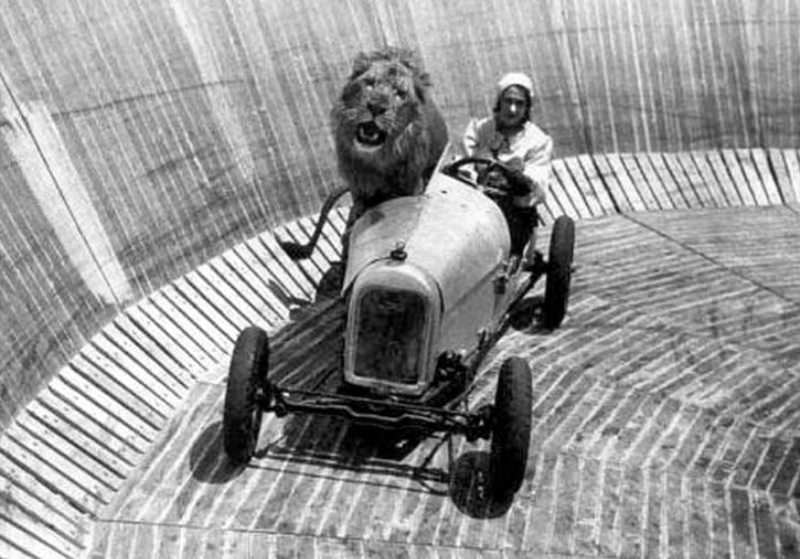
Roaring around a steep wooden motordrome, Lillian La France sits at the controls of a stripped-down racing machine while a full-grown lion rides beside her, jaws open as if sharing the thrill. The curved wall of planks and the blurred lines under the wheels emphasize speed, risk, and the razor-thin margin between spectacle and disaster. Few images sum up 1930s sports entertainment so starkly: daring, theatrical, and engineered to make an audience gasp.
Women who entered the world of motorcycle stunt riding had to conquer more than the track itself; they faced a culture that treated high-speed competition as a man’s domain. La France’s act—part motorsport, part circus—signals the era’s fascination with novelty and extremes, when promoters blended mechanical prowess with live-animal bravado to sell tickets. The photo’s composition, with rider, machine, and predator sharing a cramped cockpit, turns skill and nerve into a single dramatic tableau.
For readers interested in early women in motorsports, this historical photograph offers a vivid window into the showmanship that surrounded stunt riders in the 1930s. It also highlights how performance and danger were marketed as “sport,” long before modern safety standards and regulated arenas reshaped public expectations. Whether you arrive here searching for Lillian La France, motordrome history, or vintage motorcycle stunts, the scene lingers as a reminder of how far athletes—and their audiences—once pushed the limits.