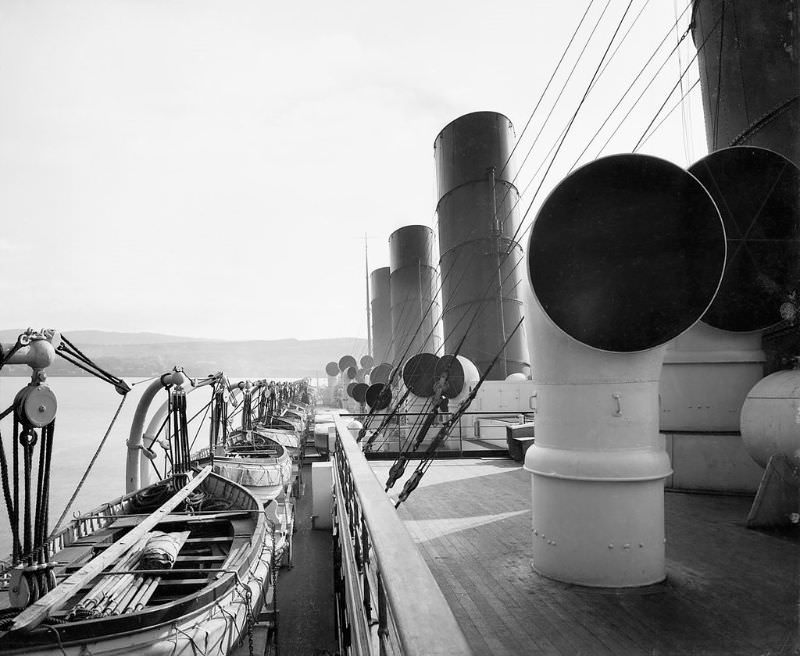
High above the promenade, Aquitania’s flying bridge offers a commanding sweep down the ship’s flank, where lifeboats sit cradled in their davits and the sea stretches outward to a hazy shoreline. From this elevated walkway, the long lines of rigging and rails guide the eye toward the horizon, hinting at the steady forward purpose of an ocean liner underway or preparing to depart. The perspective feels both airy and industrial, balancing open water with dense, functional detail.
Dominating the right side are the great ventilators and a procession of towering funnels, their rounded forms and stark shadows emphasizing the scale of early 20th-century marine engineering. Cables, winches, and deck fittings appear in crisp succession, a working landscape designed for safety, endurance, and speed rather than ornament alone. For readers interested in “inventions,” the flying bridge itself speaks to an era when navigation, visibility, and shipboard organization were being refined on a grand scale.
Along this corridor of wood decking and steel, everyday routines would have unfolded—officers scanning ahead, crew tending gear, passengers catching a wind-swept view between destinations. The photograph invites a closer look at ocean liner architecture: lifeboat arrangements, ventilation systems, and the practical geometry that kept a floating city running. As a historical image tied to the RMS Aquitania, it’s a compelling window into maritime history and the design thinking that shaped transatlantic travel.