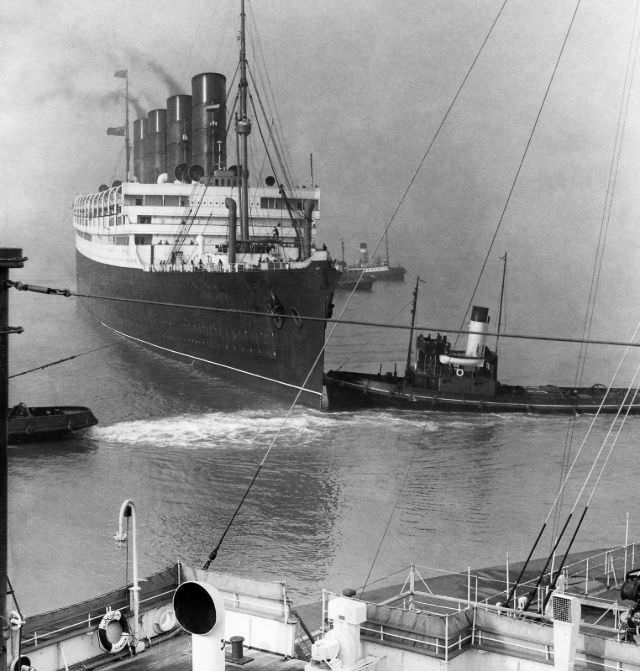
Aquitania looms into Southampton Water with the quiet authority of a true ocean greyhound, her high bow cutting a soft wake as tugboats fuss alongside. Four tall funnels dominate the skyline, and the ship’s layered decks and rows of portholes hint at the scale of the transatlantic trade that made liners into floating cities. In the foreground, rigging lines and deck fittings from another vessel frame the scene, putting the viewer right on the working waterfront.
After the First World War, Southampton increasingly displaced Liverpool as Britain’s “big ship” terminal, and this arrival speaks to that shift in maritime geography. The harbor is busy but controlled: a small tug throws churned white water against the liner’s dark hull, while distant silhouettes of other ships sit in the haze beyond. Even without close-up faces, the human presence is implied by the orderly choreography of docking—ropes, pilotage, and muscle power translated into motion by steam and skilled hands.
For readers interested in Cunard history, interwar travel, and the technology of early 20th-century passenger ships, this photograph offers a concentrated slice of the era. It’s a reminder that ocean liner glamour depended on industrial infrastructure—ports, tugs, crews, and timetables—working in unison to deliver arrivals that felt effortless to those on board. As a piece of Southampton maritime history, the image captures both the grandeur of Aquitania and the everyday mechanics of a major British port at work.