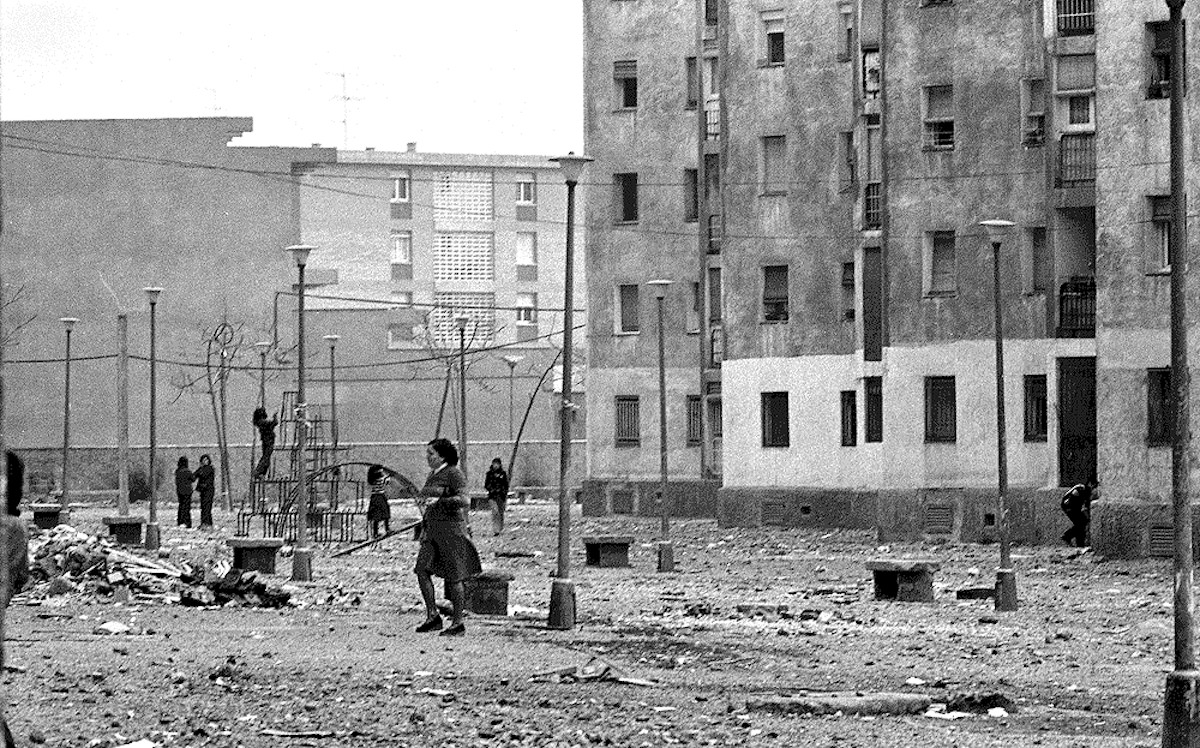
Between raw dirt, scattered rubble, and a few stark streetlamps, children carve out a playing field in Barri de Sant Roc, Badalona, in 1976. Apartment blocks rise close and worn, their façades forming a hard backdrop to a scene that still feels lively and improvised. A simple metal frame becomes playground equipment, and the open ground turns into a shared arena where movement and laughter seem to matter more than the state of the streets.
What stands out is the resourcefulness of everyday sport: no marked lines, no proper pitch, just bodies in motion and friends clustered at the edges as spectators. The composition pulls the eye from the small groups in the distance to the figures nearer the foreground, emphasizing how public space in working neighborhoods often served multiple roles at once. In this corner of metropolitan Barcelona, play appears as a kind of neighborhood infrastructure—built from attention, habit, and the willingness to make do.
For readers interested in vintage Barcelona photography, 1970s street life, or the social history of Badalona, this image offers a textured glimpse of childhood and community on the urban fringe. It hints at a period when new housing and unfinished surroundings coexisted, and when the street itself was the most accessible sports ground. The title anchors the moment—Barri de Sant Roc, Badalona, Barcelona, 1976—while the photograph invites closer looking at how a place is lived in, not merely constructed.