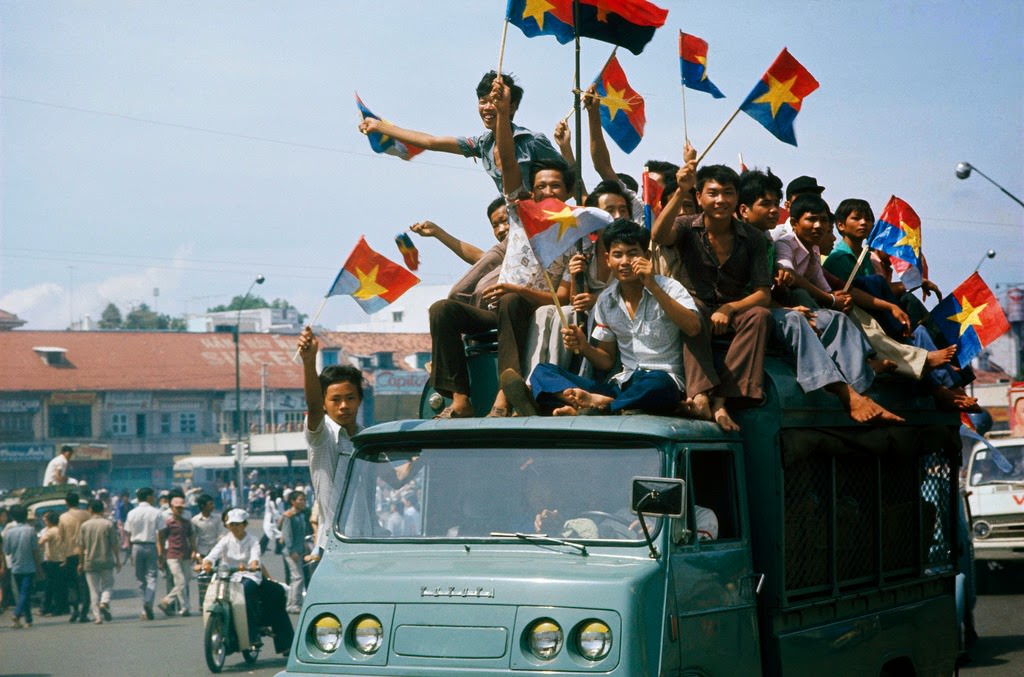
A truck pushes through a crowded street as young men perch on its roof and sides, waving bright flags with a yellow star. Faces lean into the wind with wide grins and raised arms, turning the vehicle into a moving stage for public joy. Behind them, the city blurs into pedestrians, motorbikes, and low buildings, all caught in the momentum of a moment that felt bigger than the road beneath their feet.
The title points to the fall of Saigon, and the photograph’s energy reads as a release after years of Vietnam War tension and upheaval. Flags ripple above the crowd like punctuation marks, while the packed street suggests how quickly private emotion became communal spectacle. Even without hearing the noise, the scene conveys chanting, laughter, and the restless movement of a city reacting in real time to a decisive turning point.
For readers exploring Vietnam War history, this image offers a vivid counterpoint to the better-known visuals of evacuation and defeat. It centers ordinary Vietnamese in the act of claiming the streets—celebrating, signaling allegiance, and absorbing the shock of change. As a historical photo, it invites reflection on how “liberation” and “loss” can occupy the same hour, depending on who is looking up at those flags.