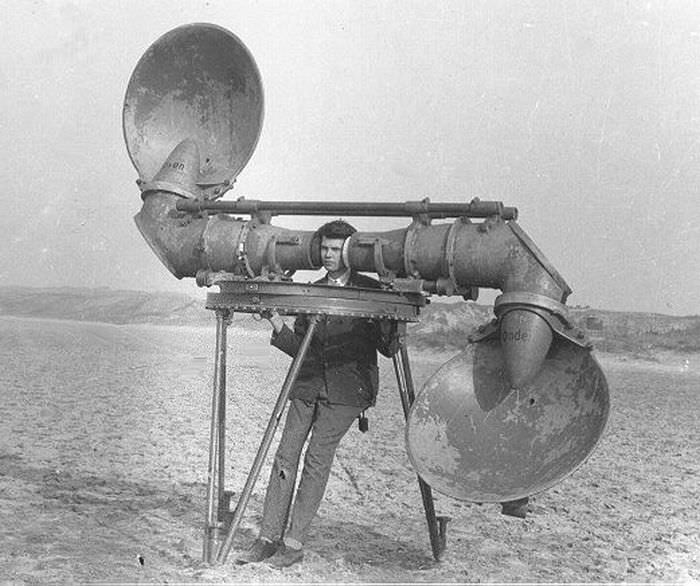
Long before radar screens glowed in operations rooms, air defense often depended on nothing more than ears, patience, and oversized engineering. The photo centers on a field-deployed acoustic listening device—giant horns and pipework mounted on a sturdy frame—built to gather faint engine noise from the sky and funnel it toward a human operator. Set against an open landscape, the apparatus looks half musical instrument, half industrial sculpture, hinting at an era when sound itself was treated as a strategic resource.
The design is deceptively simple: wide horn mouths catch and concentrate vibrations, while the rigid tubing channels them to listening points that could help estimate direction and distance. Operators would rotate and align the horns, searching for the strongest signal, then relay bearings to others as part of an early-warning network. In practice, wind, weather, terrain, and the roar of the sea or nearby activity could all distort what was heard, making the work a demanding blend of technique and intuition.
Viewed today, these acoustic horns stand as a fascinating chapter in military invention and early aircraft detection technology, bridging the gap between observation posts and modern radar. They also speak to the broader story of interwar experimentation—when engineers raced to outpace aviation’s rapid advances with mechanical solutions that were big, bold, and sometimes beautifully impractical. For readers interested in historical inventions, pre-radar air defense, and the evolution of surveillance, this image offers a vivid snapshot of ingenuity on the listening line.