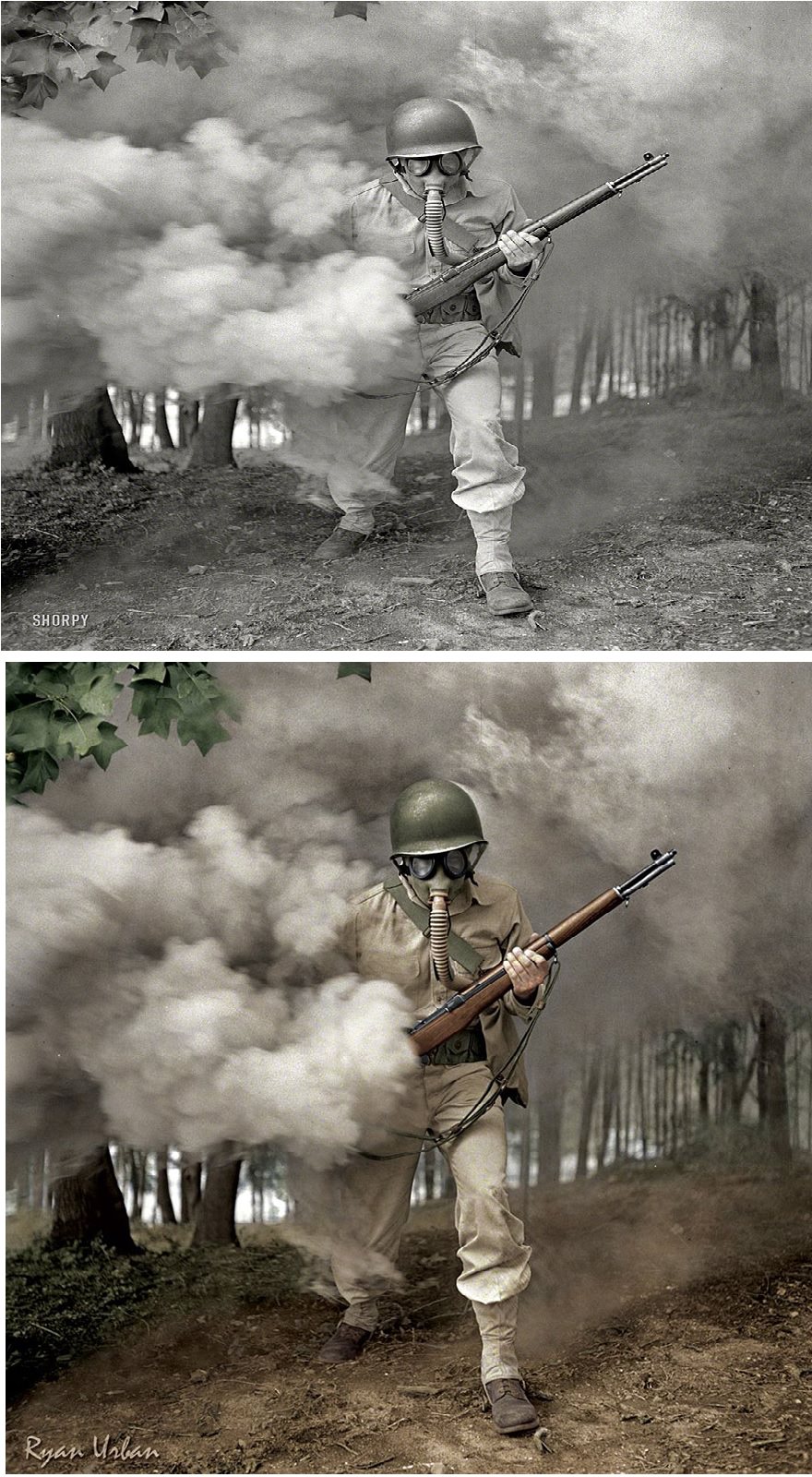
A wall of smoke curls through the trees as Sergeant George Camblair steps forward with a rifle held tight and a gas mask sealing his face, the round lenses giving him a steady, almost mechanical stare. Taken at Fort Belvoir, Virginia, in 1942, the scene balances motion and discipline—one boot planted, the other pushing on—while the smokescreen turns an ordinary training ground into something that feels abruptly like a battlefield.
Gas-mask drills and smoke tactics were more than dramatic demonstrations; they were practical lessons in keeping orientation, breathing, and control when visibility disappeared. In the frame, the mask’s hose, the snug helmet, and the gathered uniform cuffs underline how much of wartime soldiering depended on equipment working as intended under stress, not just on marksmanship or strength. The forested backdrop and low-lying haze show why smokescreens mattered: concealment could protect movement, confuse an opposing force, or simulate the chaos troops might face overseas.
The included colorization adds a fresh layer to the original photograph, emphasizing the earthy tones of the uniform and the density of the drifting smoke without changing the stark mood of the moment. For readers interested in World War II home-front training, U.S. Army preparedness, or Fort Belvoir history, this image offers a vivid glimpse of the routines that turned doctrine into muscle memory—practiced again and again until even a blinded advance became manageable.