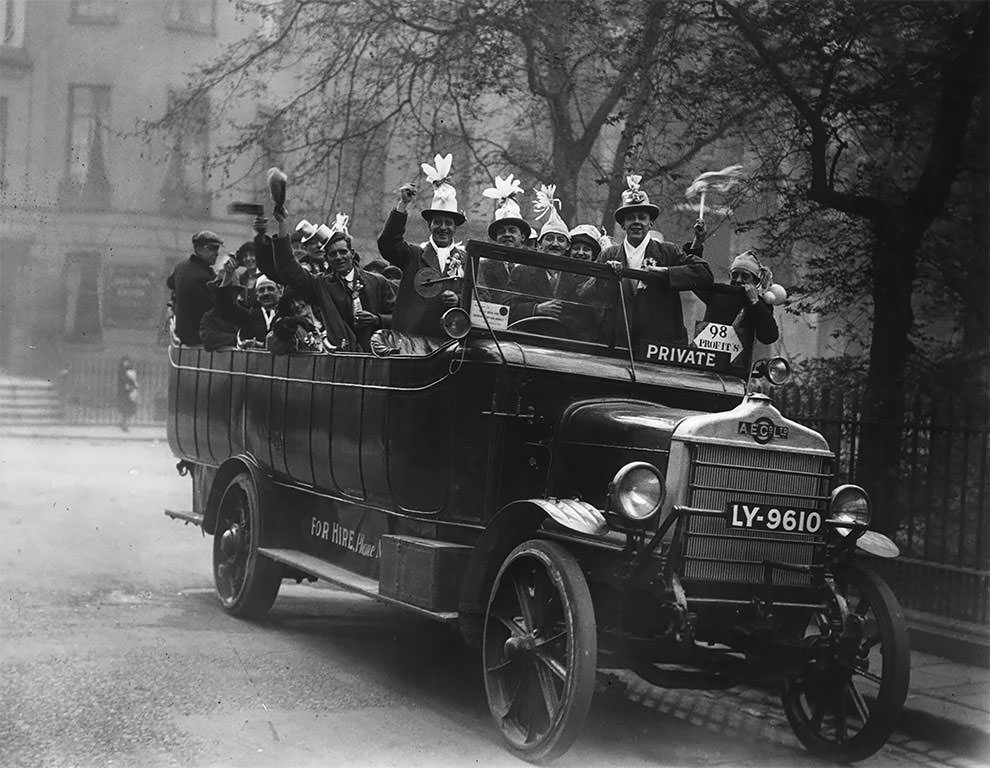
Street trees blur behind an open-top private bus as a cheerful crowd of football supporters leans over the rails, waving and calling out on the road to Wembley. Paper hats and improvised decorations sit at jaunty angles, while a hand-held horn hints at the noise they’re ready to unleash long before the first whistle. The vehicle’s “PRIVATE” board and the bold registration on the front add crisp period detail, placing the viewer right in the bustle of match-day travel in early-1920s Britain.
April 28th, 1923 wasn’t just another FA Cup final; it was a journey toward a newly completed Wembley Stadium and a fixture between West Ham United and Bolton Wanderers that drew extraordinary attention. Before crowds became a managed science, supporters arranged their own transport, turning a hired bus into a moving celebration that stitched together neighborhoods, pubs, and workplaces into one rolling chorus. What reads as lighthearted dressing-up also speaks to how quickly football had become a shared national ritual—part sport, part parade.
Energy like this explains why searches for “1923 FA Cup final,” “Wembley Stadium opening era,” and “classic British football fans” still lead people back to images like this one. The faces are anonymous, yet familiar: ordinary supporters making themselves visible, claiming space in the public street, and heading toward a ground that would soon define English football. In a single frame, the photograph preserves the anticipation, camaraderie, and DIY pageantry that have always powered cup-final culture.