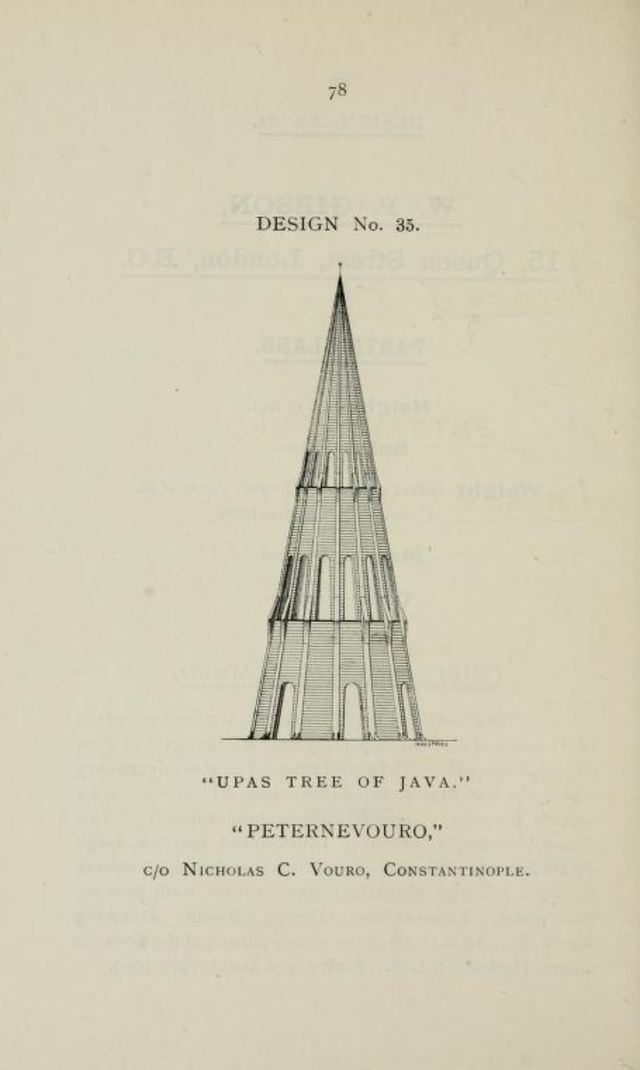
Ambition rises straight up the page in this proposed “Great Tower for London” entry, labeled DESIGN No. 35, where a needle-like silhouette narrows toward a sharp point. The drawing reads like a late-19th-century argument for height itself—clean vertical ribs, stacked tiers, and arched openings repeating like a disciplined rhythm. Even without surrounding context, the careful linework and measured symmetry place it firmly in the world of competitive architectural submissions and Victorian-era invention culture.
Beneath the sketch, the poetic title “UPAS TREE OF JAVA” sits alongside “PETERNEVOURO,” hinting at the way designers borrowed exotic references to sell modern engineering dreams. The structure’s tapering mass suggests a monument that would have been both spectacle and symbol, a tower meant to dominate London’s skyline through sheer audacity. Details like the numbered page and formal captioning reinforce that this was part of a larger portfolio—one concept among dozens competing to define what a “great tower” could be.
For readers interested in London history, Victorian architecture, and the era’s obsession with grand projects, this image offers a compact glimpse into how innovation was presented on paper before it ever met iron or stone. The post’s collection of “50+ competitive designs” becomes more than a tally when you see an entry like this: restrained, confident, and determined to impress through proportion and repetition. As a historical artifact, it captures the spirit of 1890s design competitions—where imagination, publicity, and engineering promise all vied for attention in the same narrow column of ink.