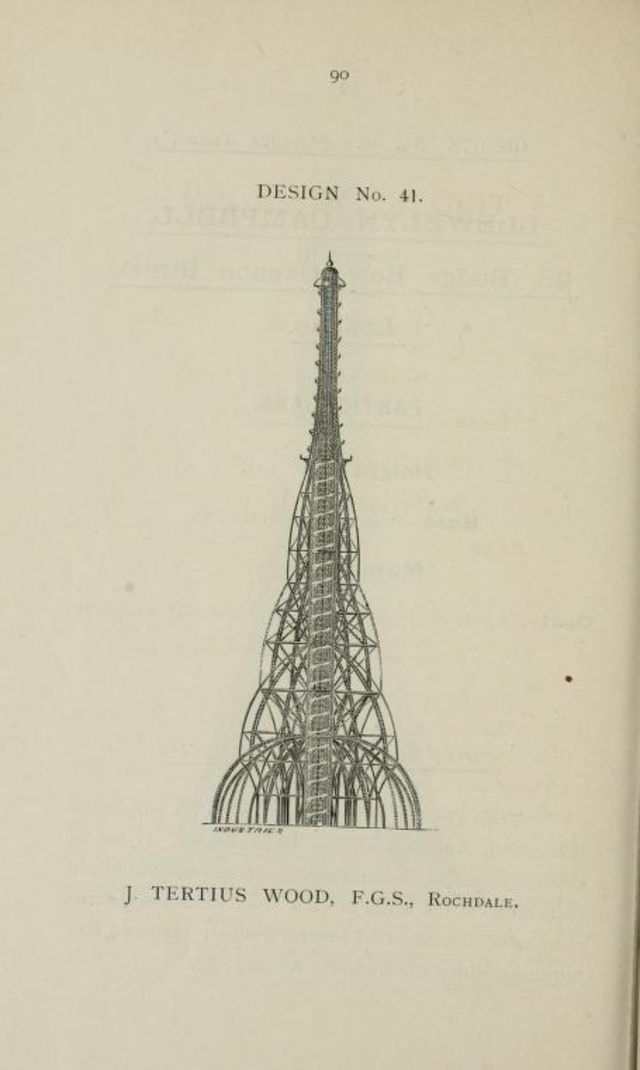
Perched on a cream-toned catalog page, “DESIGN No. 41” rises as a daring proposal for a Great Tower for London, part of the flurry of competitive designs submitted in the late Victorian age of invention. The drawing’s thin, precise linework turns engineering into spectacle, suggesting a city eager to announce modernity in iron and ambition rather than stone and tradition.
A narrow central shaft shoots upward through a bulb-like lattice of sweeping ribs, arches, and braced frameworks, as if the tower were both skeleton and sculpture. The base blooms into layered supports that feel almost botanical, while small platform-like details along the height hint at observation points and public access—an early vision of a landmark built to be climbed, visited, and marveled at.
Beneath the illustration, the printed credit to J. Tertius Wood of Rochdale anchors the concept in real-world authorship and the era’s professional networks, when designers from across Britain submitted schemes to win prestige and influence. For readers exploring 1890 inventions, Victorian architecture, and the history of unbuilt London, this page offers a vivid glimpse of the imagination that surrounded the idea of a “great tower”—one of many competing dreams on paper before any skyline could be changed.