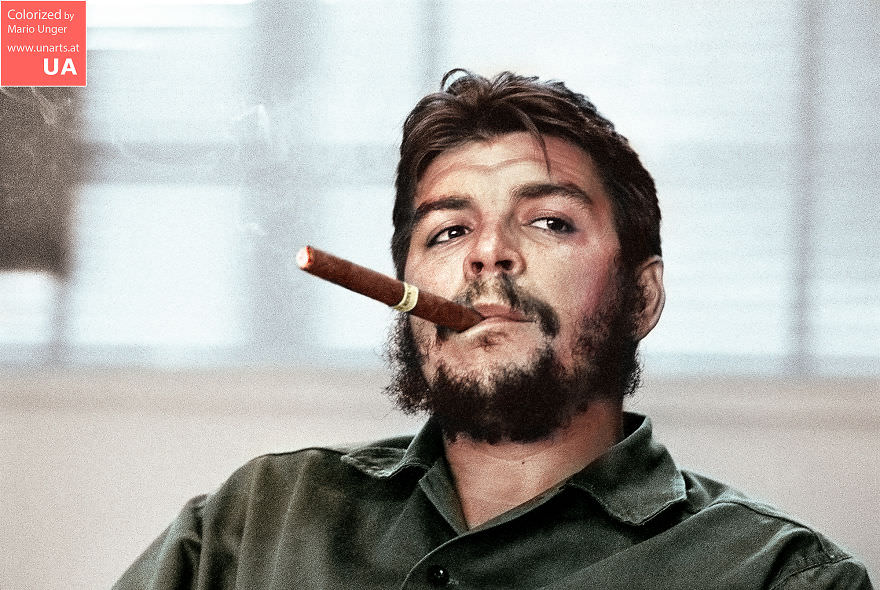
A steady, unguarded gaze meets the viewer as Che Guevara leans back with a cigar held at an angle, his expression hovering between contemplation and defiance. The colorization brings out the earthy tones of his shirt, the warmth in his skin, and the texture of his beard and hair, lending a striking immediacy to a figure so often encountered only in stark monochrome. Set against a soft, indistinct background, the portrait keeps attention on posture, face, and the small details that make an icon feel human again.
Seen up close, the image reads less like propaganda and more like a candid moment caught in a pause between events. The relaxed collar and informal pose suggest an interior setting, while the smoke and the far-off look hint at the heavy atmosphere of politics and revolutionary myth that has long surrounded his likeness. Color, in this context, doesn’t sanitize history; it changes the emotional temperature, pulling the scene closer to the present and inviting a slower look.
For readers searching for a Che Guevara photo, colorized historical portrait, or vintage revolutionary imagery, this post offers a vivid entry point into how photographs shape memory. Guevara’s face has been endlessly reproduced, yet portraits like this remind us how much the medium matters: what we notice, what we project, and how distance collapses when the past is rendered in lifelike tones. Whether approached as political history, visual culture, or the evolution of archival restoration, the image remains a compelling artifact of twentieth-century legend.