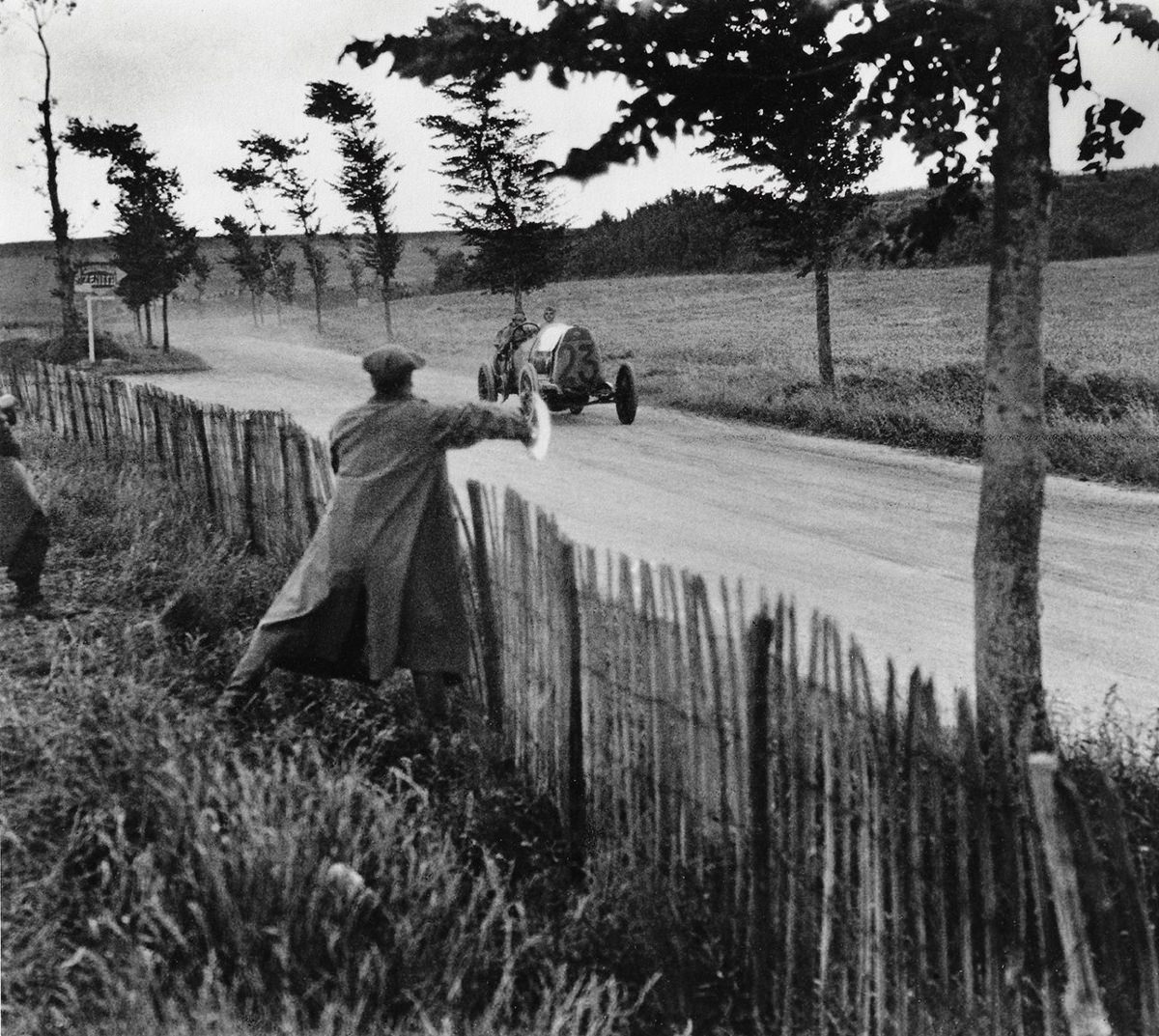
At the edge of a country road, a lone figure leans over a rough wooden fence and throws an urgent arm into the air, a split-second gesture meant to cut through engine noise and flying dust. In the distance an open-wheel racing car barrels along the straight, its driver and riding mechanic exposed to the wind, the machine framed by a line of trees and wide, empty fields. The scene feels both quiet and dangerous—an improvised stage where spectators stand just feet from speed.
The title identifies the signalman as Nazzaro, urging Wagner to accelerate during the Grand Prix de l’A.C.F. on June 26, 1912, and the photograph turns that instruction into a vivid moment of early motorsport strategy. Before pit boards and radio, communication could be as direct as a wave beside the roadway, a human semaphore flashing information at racing pace. Details like the fencing, the narrow surface, and the open cockpit underline how much bravery and trust were built into every mile of Grand Prix racing in this era.
For readers drawn to automotive history, this is a strong glimpse of the culture surrounding pre-war racing: rural courses, minimal barriers, and a community pressed close to the action. The composition emphasizes motion and distance, letting the road pull the eye toward the oncoming car while the outstretched arm anchors the drama in the foreground. As a WordPress feature, it pairs well with themes of early 20th-century athletics, vintage racing photography, and the origins of the Grand Prix tradition.