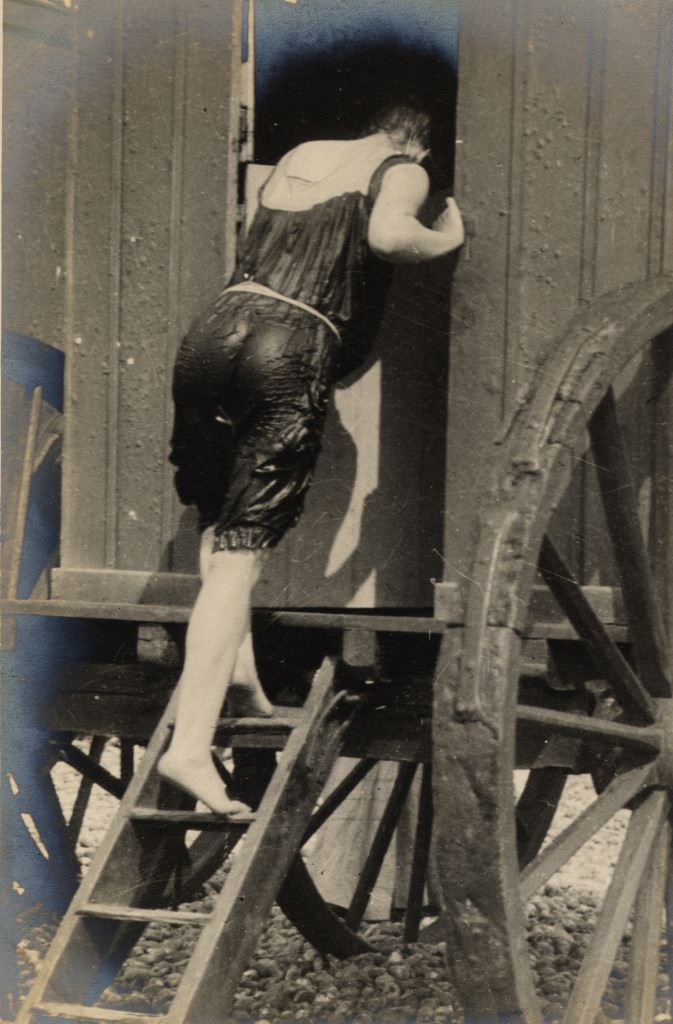
Bare feet find the wooden steps as a woman climbs back into a bathing machine, her wet bathing costume clinging and dark against the sunlit boards. The cart’s tall plank sides frame a small doorway where she ducks inside, one hand braced on the doorframe, the other pulling herself out of the open air. Pebbles under the wheels and the sturdy ladder emphasize the practical, workmanlike design behind a day at the seaside.
Bathing machines were a familiar feature of British beach culture in the late 19th and early 20th centuries, offering privacy for changing and a measure of modesty when entering or leaving the water. Rolled down toward the surf, they acted as mobile changing rooms so swimmers could avoid parading in public, especially at resorts where etiquette still shaped leisure. The scene captures that moment between freedom and propriety: the brisk return from a swim and the quick retreat into a private space.
Details of Edwardian swimwear and seaside fashion sit quietly in the image—knee-length bottoms, a sleeveless top, and the sense of weight and dampness that early fabrics carried after saltwater. The photograph also hints at the mechanics of beach life, from the heavy wheels to the elevated platform that kept the doorway above rough ground. For anyone interested in social history, coastal holidays, and vintage beach photography, it’s a vivid glimpse of how recreation, technology, and manners met on the shore.