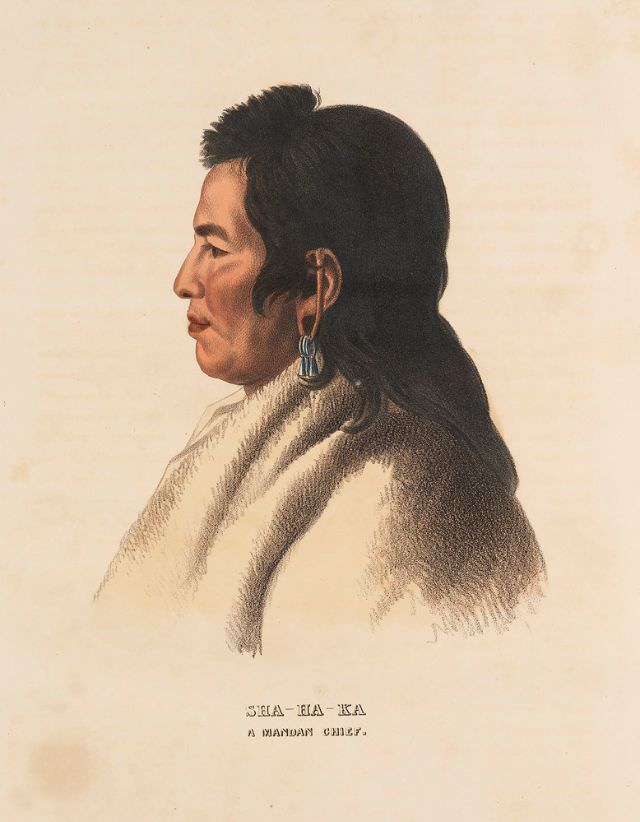
Sha-Ha-Ka is rendered in a striking side-profile portrait that emphasizes presence over ornament, inviting the viewer to linger on expression, posture, and careful detail. Long, dark hair falls behind the shoulder, while a single dangling earring and a pale robe or wrapped blanket provide quiet contrast against the softly tinted background. The inscription beneath the figure—“SHA-HA-KA, A MANDAN CHIEF”—anchors the artwork as both identification and tribute.
In the tradition of early Native American portraiture, the composition favors clarity and dignity, using clean outlines and gentle shading to model the face and hair. The warm tones on the skin and the minimal setting keep attention fixed on the sitter, turning a simple profile into a study of character. As an artwork reproduced for print, it also reflects how Indigenous leaders were introduced to wider audiences through illustrated images rather than photographs.
For readers searching for Mandan history, Native American leaders, or classic ethnographic art, this piece offers a compelling glimpse into how Sha-Ha-Ka was visually remembered. It carries the double weight of artistry and representation, reminding us that every historical portrait is shaped by the hands, materials, and cultural assumptions of its maker. Whether approached as a collectible print or a historical document, the image encourages a closer look at the people and nations too often reduced to captions.