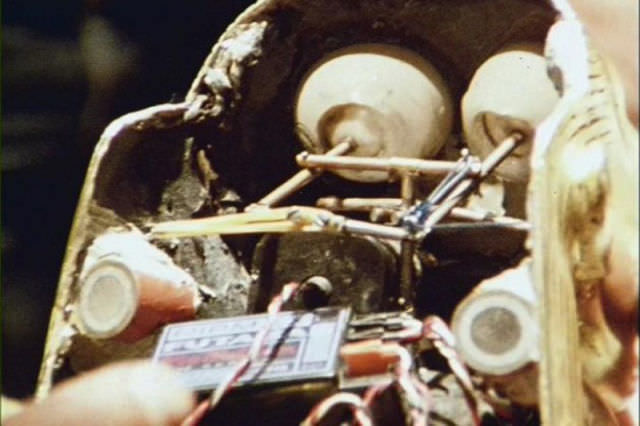
Peering beneath the “fertility idol” prop reveals a surprisingly technical interior: a hollowed shell packed with rods, linkages, wiring, and small components arranged with the precision of a workshop rig. The round, eye-like forms sit high in the cavity, while a tangle of cables and a compact control unit occupy the lower section, giving the whole build the look of a practical-effects experiment rather than an ancient relic. It’s the kind of behind-the-scenes glimpse that instantly reframes a familiar movie moment as engineered illusion.
What makes this piece especially memorable is the idea promised by the title—robotic eyes designed to track Indiana Jones—turning a static idol into a reactive character in its own right. The mechanical arms and brackets suggest how the gaze could be nudged or steered, translating off-camera control into a subtle on-screen “look” that audiences would read as eerie intent. Practical effects often rely on such hidden choreography: movement doesn’t need to be large, just convincing enough to trigger the viewer’s instincts.
For fans of Movies & TV history, the photo is a reminder of how much storytelling once lived inside the props themselves, long before digital fixes became the default. The scuffed interior surfaces and exposed hardware speak to iterative builds, quick adjustments, and the hands-on problem-solving that defined blockbuster craftsmanship. As a searchable slice of film production design, it’s a perfect companion to any deep dive into Indiana Jones props, animatronics, and the practical magic behind iconic adventure cinema.