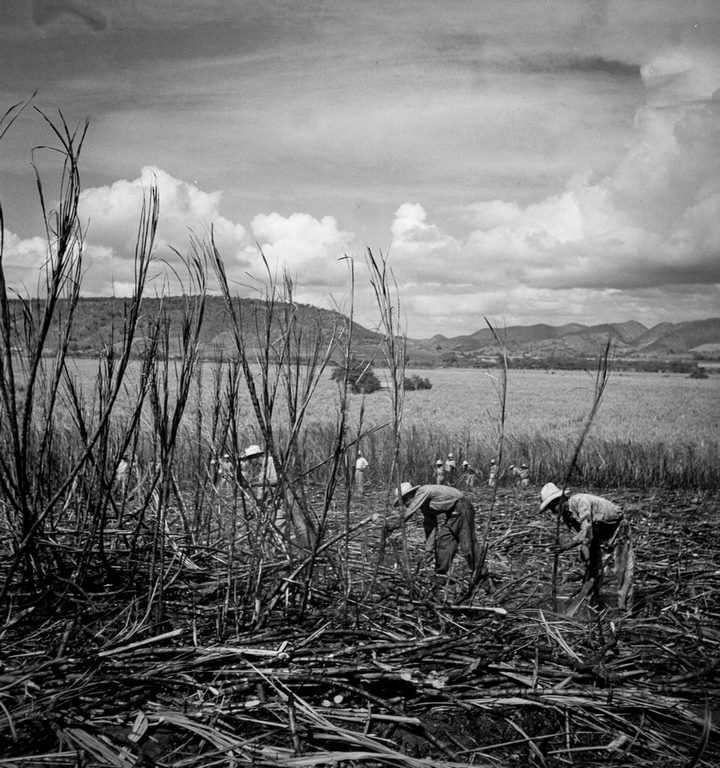
Bent backs and wide-brimmed hats break the horizon as laborers move through a sugarcane field near Guánica, cutting and gathering stalks from rows that stretch toward the low hills. The foreground is littered with stripped cane, a dense weave of leaves and stems that hints at the pace and intensity of harvest work. Above it all, a broad Caribbean sky hangs heavy with layered clouds, giving the scene both openness and weight.
What stands out is the contrast between scale and effort: the landscape feels immense, yet the job is measured in hand motions—reach, cut, pull, stack—repeated again and again. Tall cane rises like a thin curtain around the workers, partially hiding the line of figures deeper in the field and emphasizing how easy it was for people to disappear into the labor itself. The distant ridges and patchwork of farmland suggest a region shaped by agriculture, where fields were not just scenery but the engine of daily life.
Near Guánica, sugarcane cultivation tied land, industry, and community together, and images like this preserve the human dimension of that economy. The photograph invites a closer look at tools, posture, and terrain—small details that speak to working conditions and the rhythms of seasonal harvest. For readers exploring Puerto Rico history, sugarcane labor, or Caribbean agricultural landscapes, it offers a grounded, unsentimental window into places and people at work.