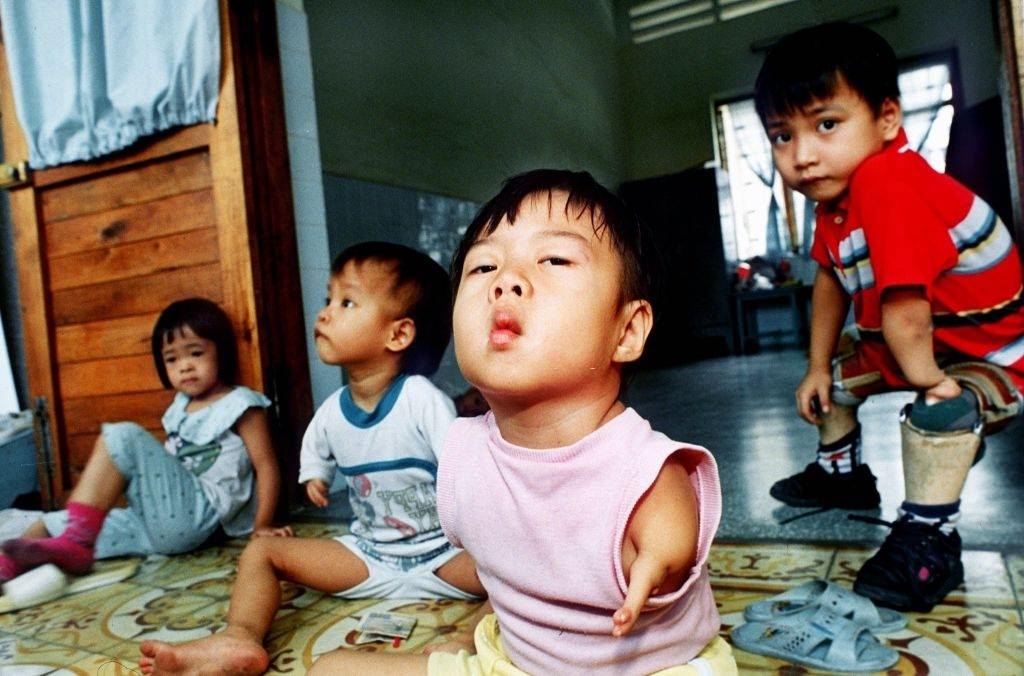
Inside a simple hospital room at Tu-Du in Ho Chi Minh City, several small children gather on patterned floor tiles, their bright clothes and curious faces pulling the viewer close. One child sits in the foreground in a sleeveless pink top, mouth slightly open as if mid-sound, while others linger behind—one resting near a wooden wall and another seated upright, watching something outside the frame. The scene feels informal and lived-in, with sandals scattered nearby and daylight filtering through an open doorway.
Taken in July 1993 at the Agent Orange Victim Care Center, the photograph quietly links everyday play to the long shadow of the Vietnam War and chemical exposure. Without dramatics, it shows how care, rehabilitation, and childhood coexist in the same space: a place where medical need is constant, yet routines still include sitting together, exploring movement, and occupying the world with the attention only young children can command. The children’s visible limb differences and assistive supports underline why such a center existed, even years after the fighting ended.
For readers searching for historical context on Agent Orange victims in Vietnam, this image offers an intimate doorway into the postwar decades—beyond policy debates and statistics—where consequences appear in small bodies and ordinary moments. It is a reminder that history often resides in institutions like Tu-Du Hospital and in the quiet labor of caregivers, not only in battlefields or headlines. The photograph’s power comes from its contrast: vulnerability and resilience sharing the same tiled floor.