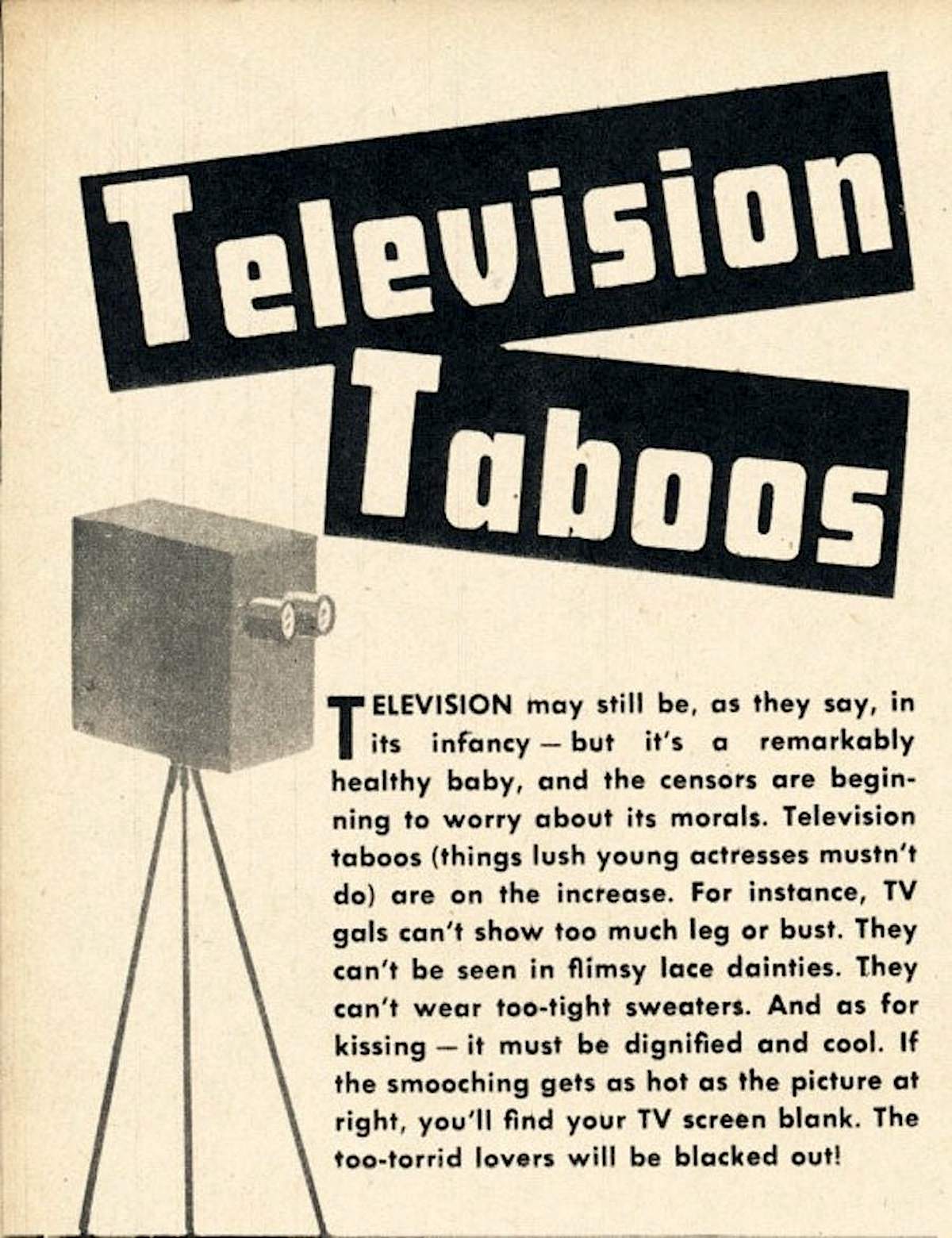
Bold, blocky lettering announces “Television Taboos,” paired with a stark illustration of an early studio camera perched on a tripod—an unmistakable nod to the medium’s formative years. The design reads like a mid-century magazine page, where typography and simple graphics did the heavy lifting, and where the promise of modern entertainment came with a warning label. Even at a glance, it signals a time when Movies & TV were not just watched, but actively policed.
Beneath the headline, the text frames television as a “healthy baby” whose “morals” have suddenly become a source of anxiety, revealing how quickly cultural gatekeeping followed technological novelty. The passage lays out the era’s on-air rules for women’s appearance—how much leg could be shown, what lingerie could be implied, and what clothing might be deemed too suggestive—turning performance into a careful negotiation with censors. In doing so, the page becomes a small but telling artifact of broadcast standards, gender expectations, and the uneasy relationship between mass media and public decency.
What lingers most is the matter-of-fact tone about romance: kissing must be “dignified and cool,” and anything too “hot” risks a blank screen and a blackout. That threat of erasure captures the power networks held over storytelling, reminding us that early television history was shaped as much by restrictions as by creativity. For readers interested in classic TV censorship, vintage broadcasting rules, and the evolution of screen taboos, this “Television Taboos guidebook rules” excerpt offers a vivid snapshot of what audiences were—and weren’t—allowed to see.