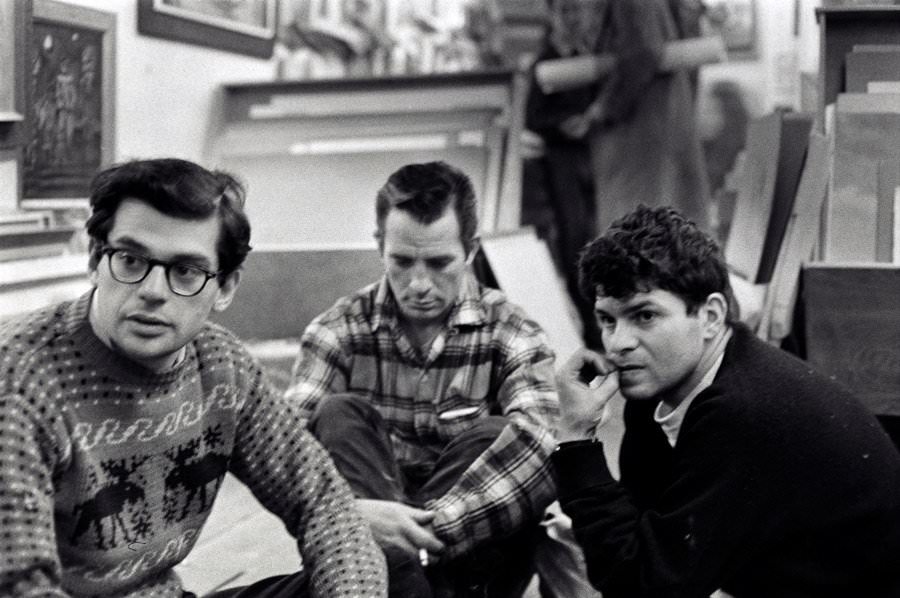
Three Beat movement writers—Allen Ginsberg, Gregory Corso, and Jack Kerouac—sit close together in New York in 1957, caught in an unguarded moment that feels more like a pause between conversations than a posed portrait. One turns toward something off-camera, alert behind dark-rimmed glasses, while another folds inward, gaze lowered, and the third rests a hand near his mouth as if weighing a line before speaking it. The composition draws you into their triangle of attention, suggesting camaraderie as much as concentration.
Behind them, the setting reads like a working interior rather than a glamorous literary stage: framed pieces lean against walls, large boards or canvases stack in the background, and a blurred figure stands amid the clutter. The casual sweaters, plaid shirt, and dark jacket anchor the scene in everyday life, the kind of room where arguments, drafts, and plans might have overlapped with art and late-night talk. It’s a reminder that the Beat Generation didn’t only happen on the page—it lived in shared spaces, friendships, and the creative mess of the city.
Seen today, the photograph offers a textured glimpse into Beat movement history at mid-century, when these writers were reshaping American poetry and prose while remaining bound to one another through long-running personal ties. The mood is intimate and slightly tense, as if each man is listening for the next spark, the next phrase, the next provocation. For readers searching for Allen Ginsberg, Gregory Corso, and Jack Kerouac in New York in 1957, this image supplies a rare sense of presence: three friends, three different energies, and a moment of literary life made visible.