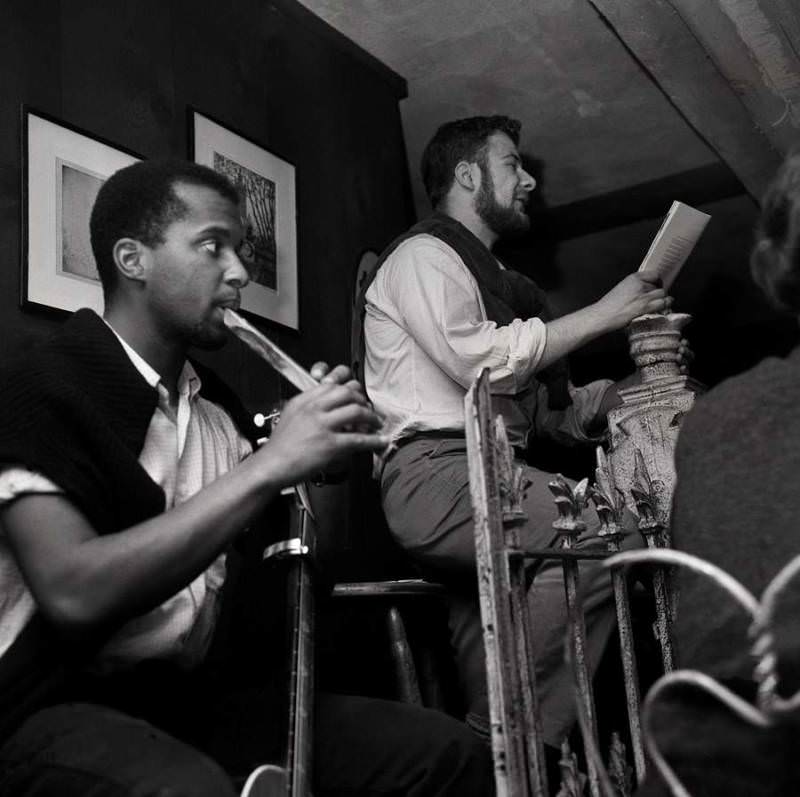
On Thompson Street in Greenwich Village, 1957, the line between sidewalk life and stage art feels delightfully thin. A flutist sits close to the camera, cheeks set with concentration as he shapes the air into music, while nearby a poet stands elevated, reading from a sheet held at arm’s length. The intimate framing suggests a small room or storefront venue where audiences gather within a few feet of the performers, turning an ordinary evening into a shared, improvised event.
Behind them, framed pictures hang on dark walls, and a low ceiling presses the scene into a cozy, club-like hush. The poet’s posture—half-turned, voice seemingly pitched over the heads in front—conjures the cadence of spoken word before microphones and big stages made it commonplace, while the flute adds a thread of melody that softens and sharpens the recitation at once. Even the hints of railings and crowded edges in the foreground evoke a packed house, where listeners lean in because there is nowhere else to be.
Greenwich Village in the 1950s is often remembered for its creative ferment, and this photograph anchors that reputation in a single, lived moment. Rather than a polished concert hall performance, it offers the immediacy of neighborhood culture: poetry read aloud, music in the room, and the audience close enough to catch every breath between lines. For anyone searching for a glimpse of 1957 New York City street culture, Village nightlife, or the roots of modern spoken-word scenes, this Thompson Street vignette delivers atmosphere with remarkable clarity.