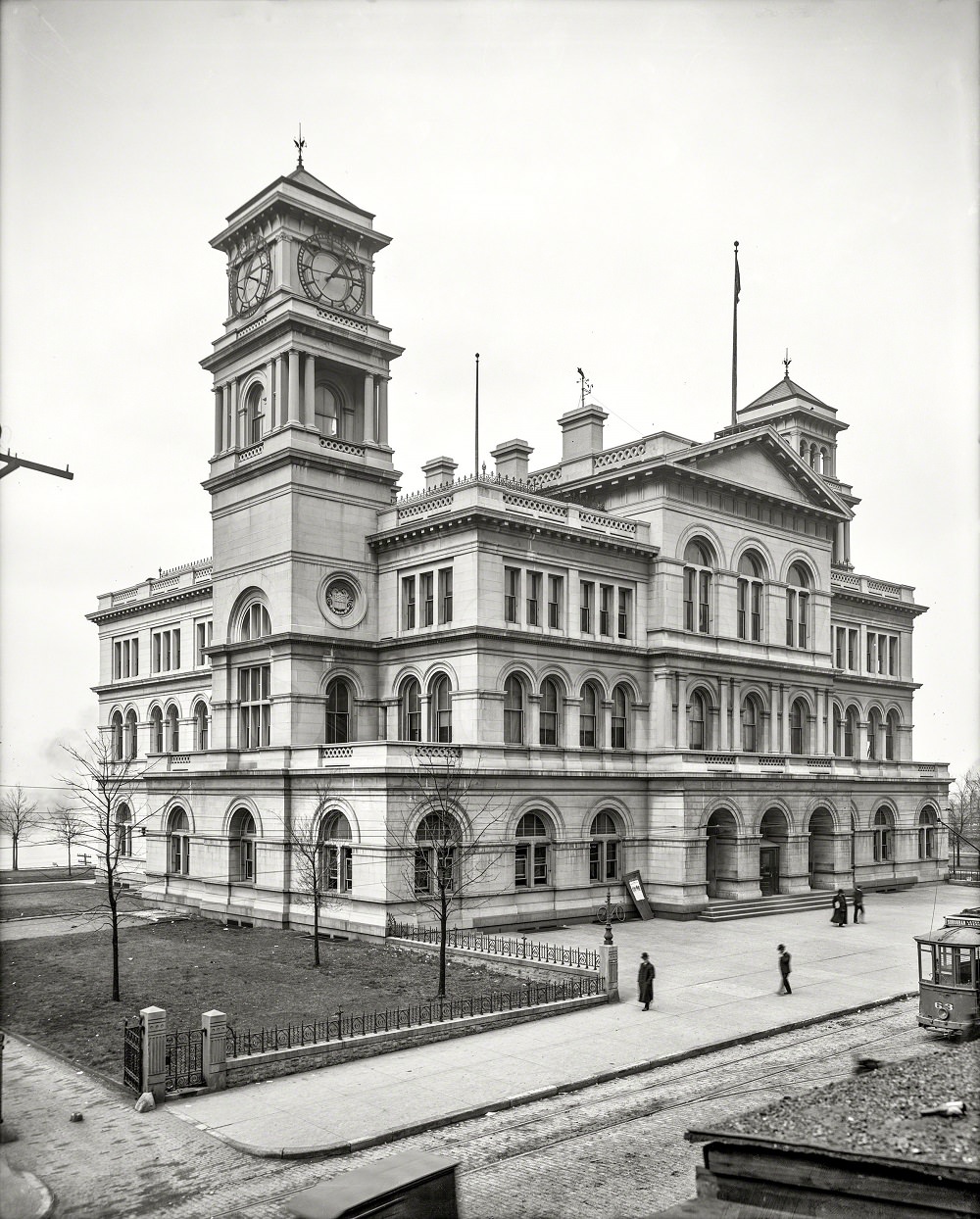
Rising above the street with a prominent clock tower and a forest of arched windows, the Custom House and Post Office in Memphis, Tennessee appears here as a confident statement of federal presence in 1906. The building’s layered stonework, deep cornices, and symmetrical massing draw the eye across multiple stories, while an iron fence and sparse trees mark the edge of the grounds. Details like rooftop balustrades and flagpoles hint at ceremony and routine alike, the everyday business of government carried out within an imposing civic shell.
Down at sidewalk level, the scene turns from architecture to lived city life: a handful of pedestrians stride past the entrance, and streetcar tracks cut across the foreground, tying this landmark to the movement of people and mail through a growing Memphis. The wide pavement and open corners suggest a downtown made for circulation—official errands, deliveries, and appointments unfolding beneath the steady gaze of the clock. Even without a bustling crowd, the photograph conveys a working district where public buildings anchored commerce and communication.
For readers interested in Memphis history, Tennessee architecture, or early 20th-century urban streetscapes, this image offers a crisp look at how the Custom House and Post Office fit into the city’s civic identity. It’s a reminder that a post office was once more than a stop for letters—it was a node in national networks, paired here with customs work and framed in monumental design. As a historical photo, it invites close viewing: the rhythm of arches, the orderly grounds, and the transit lines that connected this federal landmark to the wider city.