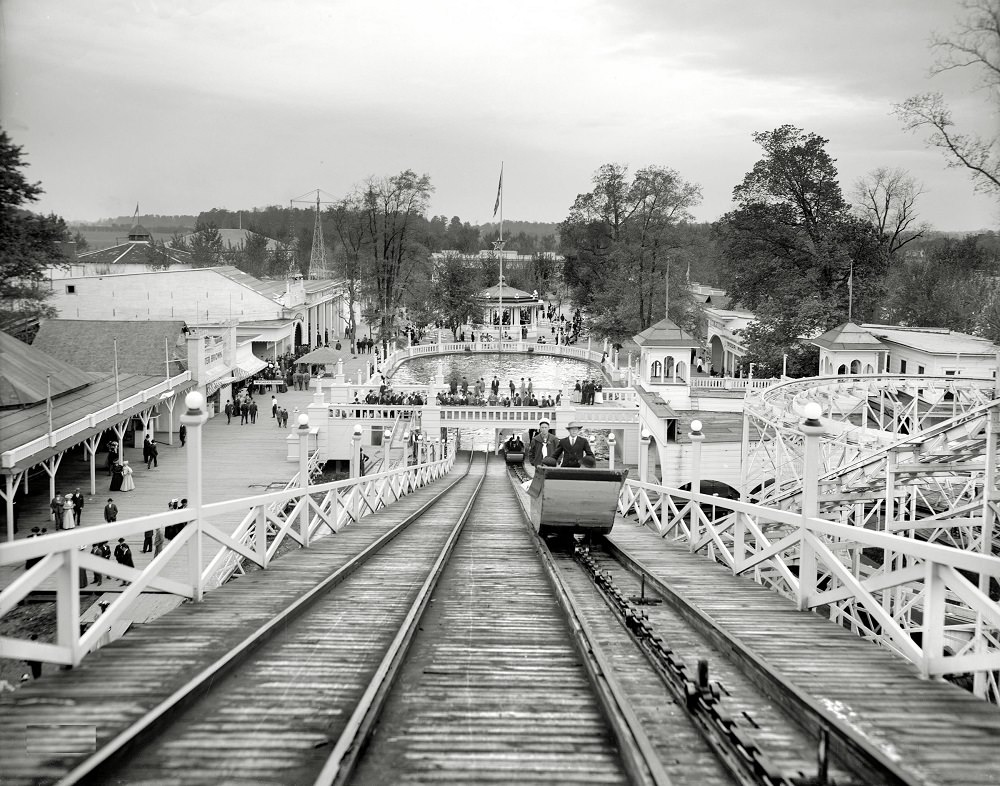
Rolling down twin wooden rails, the view opens onto Louisville’s “White City” as it appeared in 1910—an amusement landscape of bright-painted railings, promenades, and pavilion-like buildings arranged with a showman’s sense of symmetry. Crowds gather along the broad boardwalks while a ride car crests the track in the foreground, turning the scene into a moment of motion rather than a static postcard. Beyond the structured lines of the park, tall trees form a soft boundary that reminds you this lively place sat within a larger, quieter world.
At the center, a long reflecting pool (or lagoon) draws the eye toward a small bandstand or focal pavilion, where visitors cluster as if for music, announcements, or simply the pleasure of being seen. The architecture favors light tones and decorative trim, a style that gave many early-20th-century pleasure grounds their “white city” nickname and their clean, theatrical glow. Even without hearing it, you can almost imagine the layered soundtrack—footsteps on planks, ride machinery, and the low hum of conversation drifting over the water.
Details like the looping coaster framework at right and the dense foot traffic along the left arcade make this photograph especially valuable for anyone interested in Louisville history, amusement parks, or the everyday leisure of the Progressive Era. It’s a study in how public entertainment was built: carefully planned sightlines, inviting entrances, and spectacle framed as a safe family outing. For readers exploring “The White City, Louisville, 1910,” this image offers both places and people—an urban crowd enjoying modern thrills in a carefully curated environment.