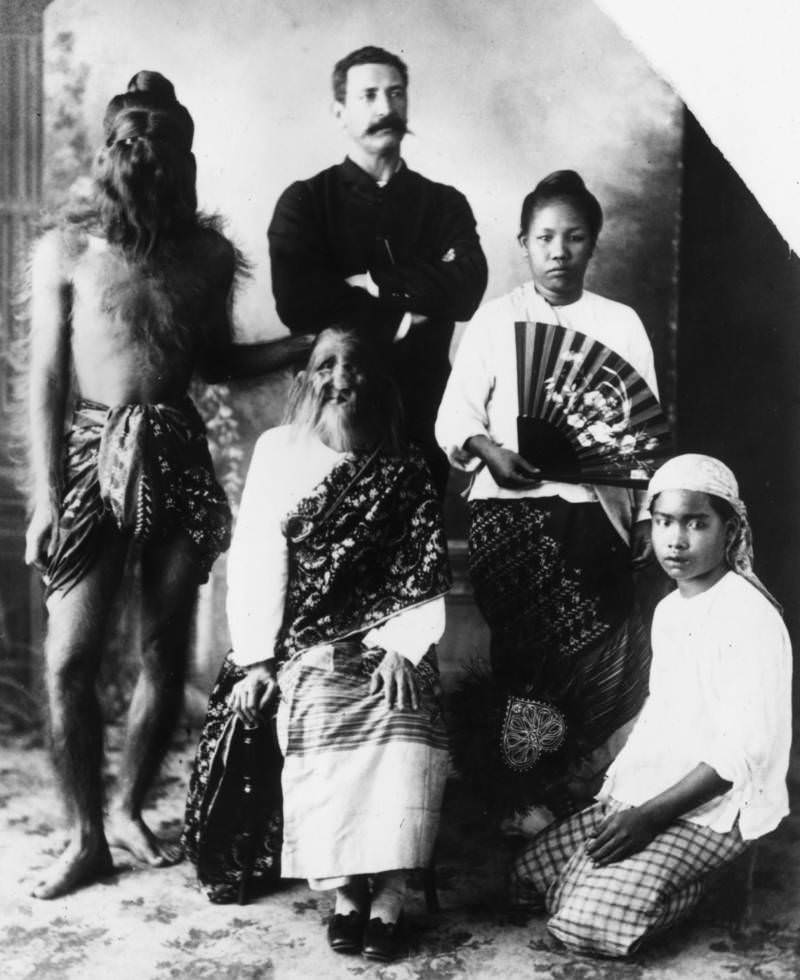
Staged against a studio backdrop, a small group poses with the careful stillness of late‑19th‑century portraiture: patterned wraps, a folded fan held at the ready, and a seated elder anchoring the composition. Two family members’ faces are notably covered in hair, a feature the title indicates was used as a selling point for audiences hungry for novelty. The overall arrangement—standing, seated, and kneeling figures—suggests an image made not simply as a keepsake, but as an advertisement of “attractions” meant to travel and be seen.
Behind the formal pose sits a more complicated story about entertainment, empire, and the way “exotic” identities were packaged for Western consumption. P.T. Barnum’s name in the title places the photograph squarely within the world of American showmanship, where human difference was routinely displayed as spectacle. Clothing and props read as curated signals of origin and tradition, while the presence of a plainly dressed man at center emphasizes management, mediation, and control in the production of such images.
For readers exploring circus history, Barnum promotions, and the visual culture of the 1890s, this photograph offers a stark window into how families could be turned into marketable curiosities. It is best approached with attention to the individuals as people—caught between their own lives and the narratives imposed on them—rather than as mere oddities. As a historical source, the portrait invites questions about consent, labor, and representation, and about what the camera chose to emphasize when “attraction” was the goal.