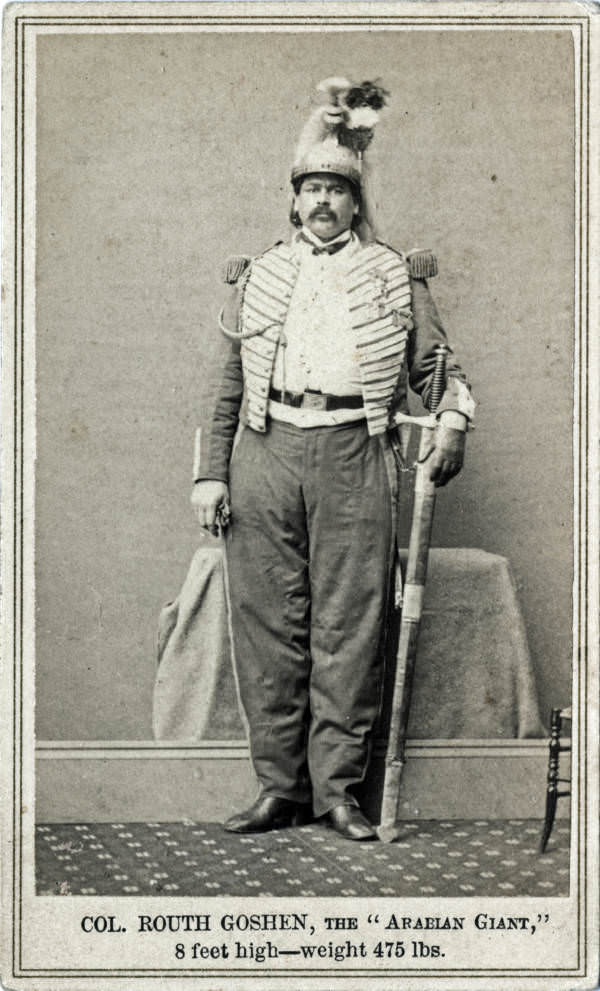
Colonel Routh Goshen stands squarely before a plain studio backdrop, turning the photographer’s spare setting into a stage for spectacle. His publicity costume leans into military bravado—braided jacket, epaulettes, and a plumed helmet—while a heavy moustache and steady gaze keep the performance grounded. Even without motion, the pose feels deliberate, designed to make the viewer look him up and down and linger on the sheer scale suggested by his presence.
At the bottom of the card, bold printed text brands him “the Arabian Giant,” a reminder that 19th-century entertainment often relied on exotic nicknames and grand claims to draw crowds. The caption also advertises a dramatic height and weight, transforming a portrait into an early form of show-business marketing. Studio photography in this era wasn’t just documentation; it was promotion, meant to be collected, shared, and talked about like a poster in pocket size.
Behind the theatrical uniform and the carefully chosen props, the photograph also hints at the everyday realities of posing in 1865: the rigid stance, the uncluttered wall, and the minimal furnishings at the edge of the frame. Details in the clothing, floor pattern, and card-style presentation make it a rich artifact for anyone searching for Civil War-era studio portraiture, Victorian sideshow history, or the visual culture of “human curiosities.” For readers exploring how fame was manufactured before mass media, this image of Colonel Routh Goshen offers a vivid, unsettling window into the period’s fascination with size, identity, and spectacle.