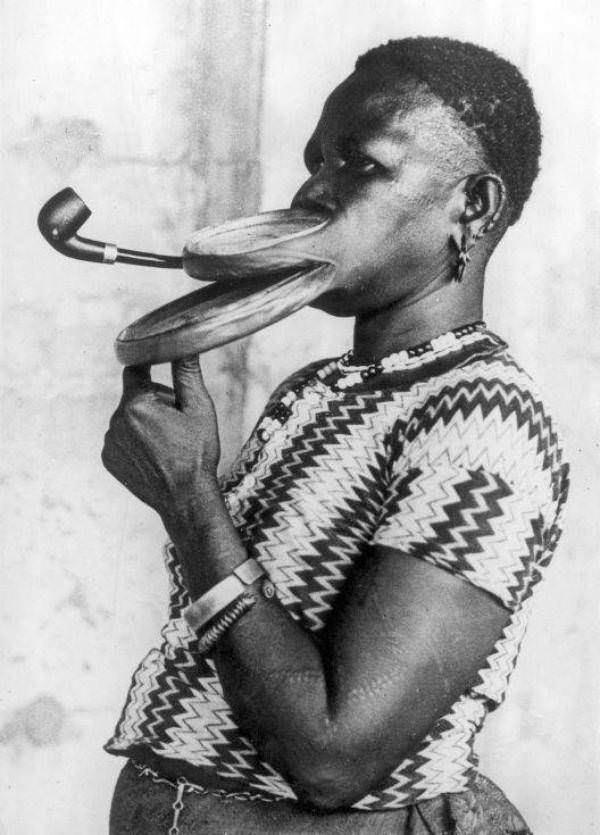
Madam Gustika is posed in crisp profile, calmly smoking a curved pipe that juts outward through the striking lip plates she wears. The photographer’s tight framing draws the eye to the interplay of object and body—the smooth sheen of the pipe bowl, the broad, flattened plates, and the steady hand supporting them—while her patterned blouse and simple jewelry anchor the scene in everyday material culture rather than costume alone.
Billed as being from the “Duckbill tribe,” she appears here through the lens of early-20th-century publicity, a period when promoters often used sensational labels to market “exotic” performers to curious audiences. That phrasing matters: it signals how identities were packaged and simplified for posters and newspapers, turning complex cultural practices into quick, clickable shorthand long before the internet. Reading the image today means holding two truths at once—its undeniable visual power and the commercial framing that shaped how viewers were invited to interpret her.
Seen as a 1930 historical photo, the portrait raises questions about performance, agency, and the ethics of display, making it a compelling artifact for anyone researching sideshow history, colonial-era spectacle, or the visual language of “otherness” in popular entertainment. The quiet confidence in her posture complicates the gawking tone implied by the billing, reminding us that the subject is not merely an object of fascination but a person navigating the stage and the camera on her own terms. For a WordPress post, it’s a potent starting point for discussion—about representation, marketing, and how a single photograph can preserve both presence and prejudice.