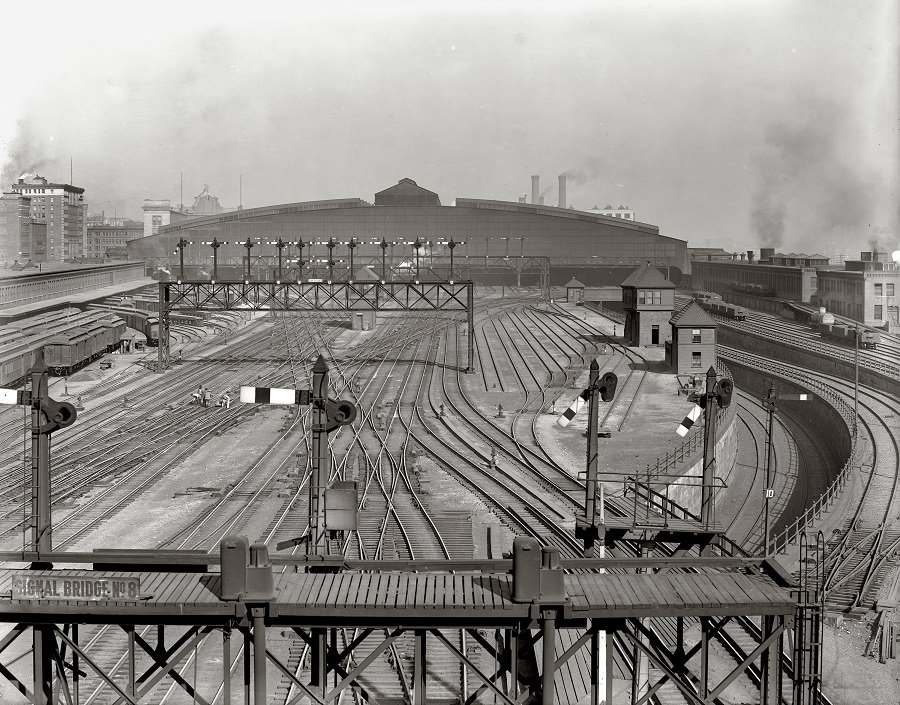
Steel rails fan outward like a hand of cards across the yard at Boston’s South Terminal Station, guiding the eye toward the broad train shed that dominates the horizon. From this elevated vantage, the complexity of early-20th-century railroading becomes legible: switches, crossovers, and parallel lines arranged to sort arrivals and departures with precision. The surrounding city peeks in at the edges—tall buildings to the left, long industrial blocks to the right—framing the station as both gateway and engine of urban movement.
Signal bridges and semaphore arms stand like a mechanical language over the tracks, communicating permission and danger to crews who could not rely on modern electronics. The crisp geometry of gantries, poles, and wires hints at the infrastructure required to keep a busy terminal safe, while smoke drifting from distant stacks situates the scene in an era of steam power and heavy industry. Even without close-up figures, the yard feels staffed and in motion, built for constant coordination among dispatchers, engineers, and yard workers.
For anyone searching Boston railroad history or the story of South Station’s early years, this 1904 view offers more than architecture—it reveals logistics. The sweep of curved approaches, the dense throat of trackwork, and the commanding presence of the terminal shed illustrate how passenger travel and freight-adjacent industry converged at the city’s waterfront edge. It’s a portrait of transportation as civic scale: a place where planning, technology, and daily rhythms met on iron rails.