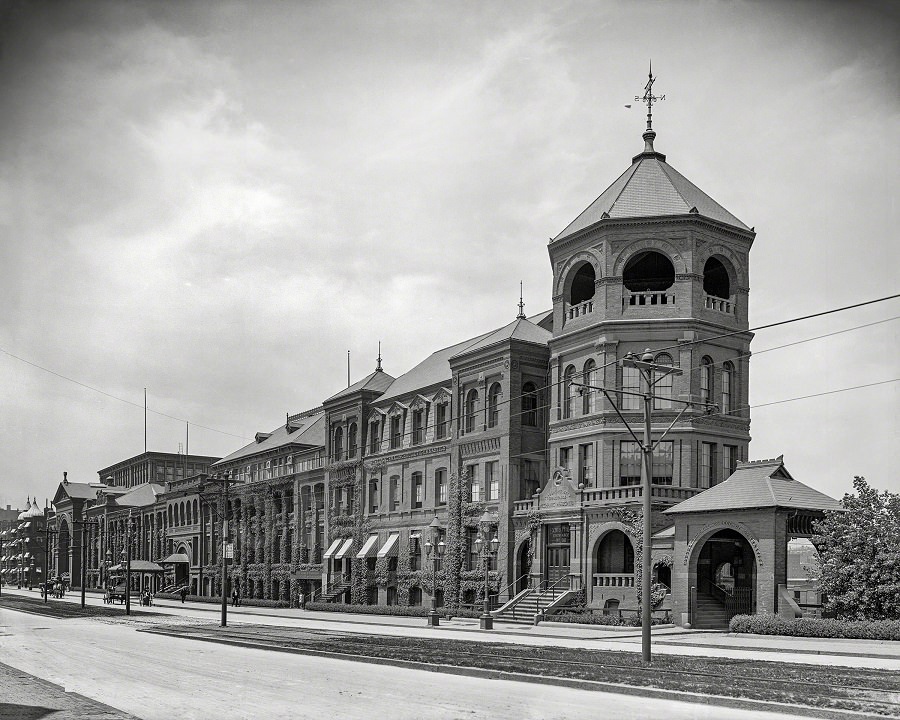
Rising above Huntington Avenue in 1906, Mechanics Hall appears as a confident piece of civic architecture, all brick massing, arched windows, and a prominent tower capped with a steep roof and weather vane. Deep-set entrances and broad steps suggest a building designed to receive crowds, while long rows of bays and trim stonework give the façade a rhythmic, institutional grandeur. Even in a still photograph, the structure reads like a landmark meant to orient a growing city.
Along the street, trolley wires and sturdy poles trace the infrastructure of early twentieth-century Boston, and the wide roadway feels built for steady movement rather than hurried traffic. A small shelter-like structure near the curb and the carefully kept edges of the grounds hint at an organized public realm, where transit, pedestrians, and prominent buildings met in everyday routines. Details like awnings, shadows under the arches, and ivy or climbing growth on the walls add texture that softens the hall’s formal presence.
The title’s reminder that Mechanics Hall was demolished in 1959 to make way for the Prudential Center turns the scene into a before-and-after meditation on urban change. What reads here as permanent—tower, cornices, and long wings extending down the block—was ultimately cleared for a different vision of Boston’s skyline and commerce. For readers exploring Huntington Avenue history, this image offers a vivid snapshot of Places & People, anchoring memory to the streetscape that modern development reshaped.