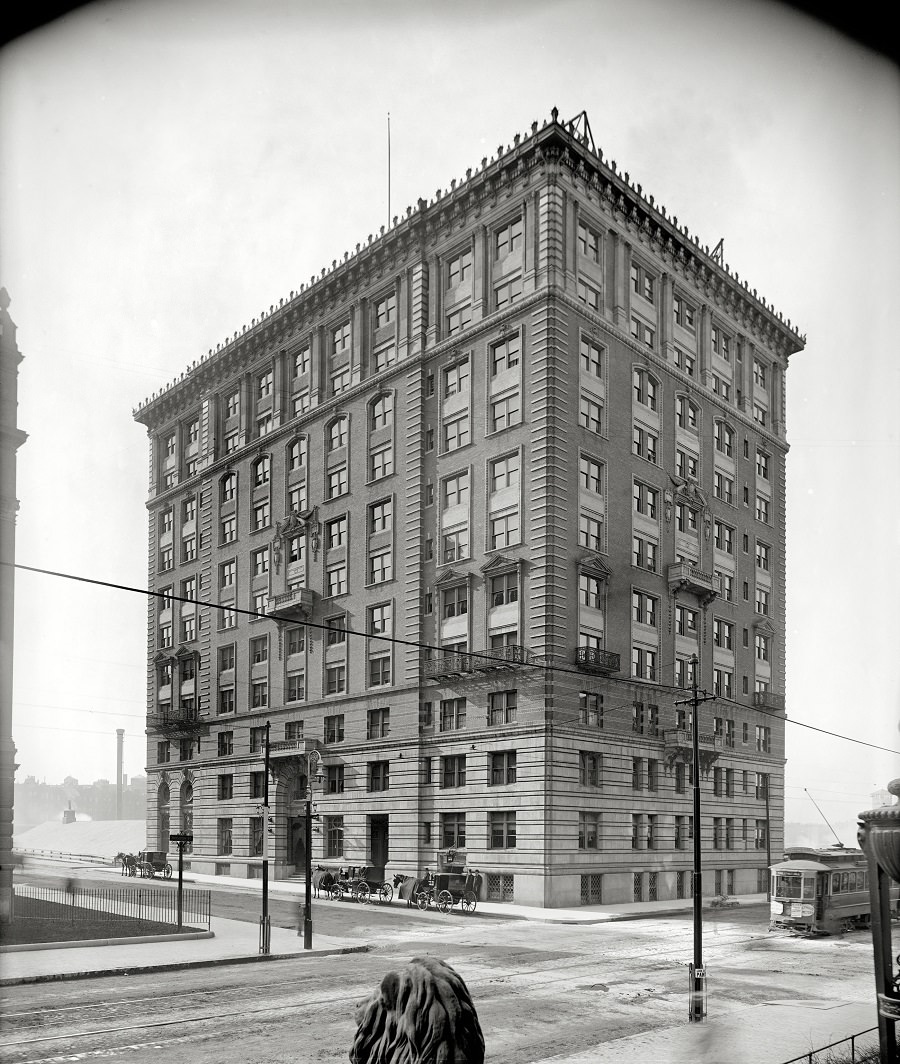
Rising above the street corner with a confident, rectilinear mass, the Hotel Lenox stands as a marker of Boston in 1906—an era when big-city hospitality was becoming an industry of its own. The building’s stacked rows of windows, pronounced corner lines, and decorative roofline give it the dignified look of a modern landmark meant to be seen from blocks away. Even without close-up detail, the façade suggests a place built to impress arriving guests with order, comfort, and permanence.
At street level, the scene feels busy in that distinctly early-20th-century way: horse-drawn vehicles gather near the entrance while a streetcar glides along the tracks, threaded by overhead wires and tall utility poles. Broad sidewalks and open roadway emphasize how much of urban Boston still revolved around rail lines and the steady rhythm of public transit. The mix of traffic hints at a city in transition, where older modes of travel shared space with electrified streetcars and expanding infrastructure.
Details like the stone base, arched entry, and small balconies help anchor this photo as more than an architectural portrait—it’s a snapshot of everyday movement around a Boston hotel at the height of its early life. For readers searching for “Hotel Lenox Boston 1906,” “historic Boston streetcar,” or “early 1900s Boston architecture,” the image offers a clear, grounded look at how the city’s built environment met the street. Seen today, the Lenox feels like a surviving witness to changing neighborhoods, technologies, and the steady flow of people through the city’s doors.