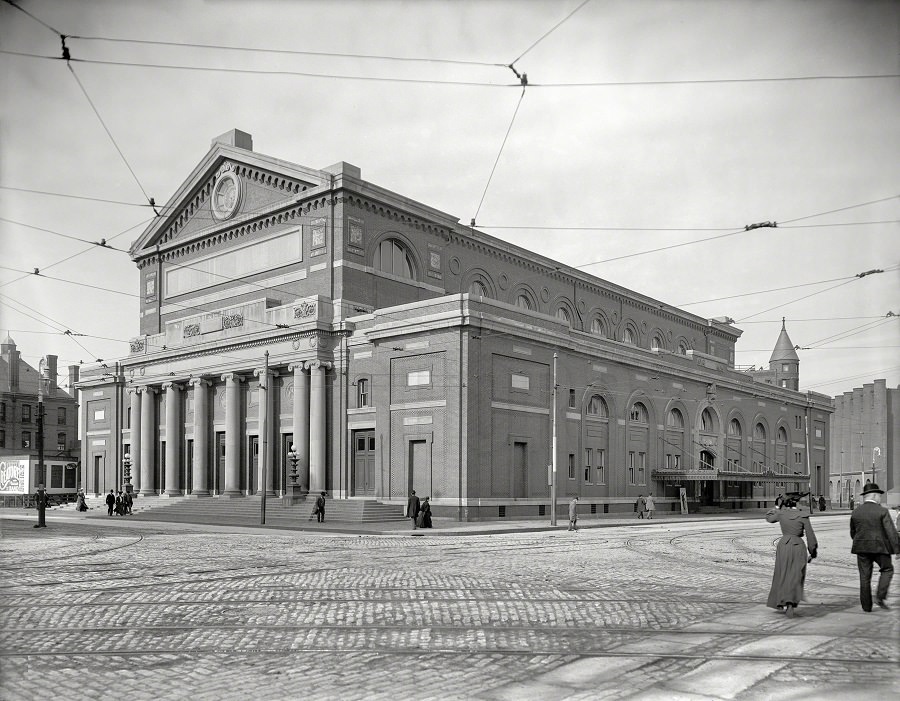
Rising from a broad cobblestone street, Boston’s Symphony Hall commands attention with its classical façade—tall columns, deep steps, and a triangular pediment that reads like a civic proclamation. The long brick flank stretches back in orderly rhythm, punctuated by arched windows and sturdy stone bands, suggesting both elegance and permanence. Overhead, a web of streetcar wires cuts across the sky, quietly placing the building within the everyday mechanics of a growing city.
At street level, the scene feels lived-in rather than ceremonial: a few pedestrians cluster near the entrance, while others cross the open intersection at an unhurried pace. Their coats and hats hint at the early twentieth century, when attending concerts was part of an expanding public culture and the neighborhood around the hall was still being shaped by new transit and new routines. Even the wide, largely uncluttered roadway emphasizes how urban space was being negotiated between foot traffic, streetcars, and the architecture of ambition.
Dated 1903 in the title, this photograph offers a memorable view of Symphony Hall, Boston at a moment when the building stood fresh and confident against a changing streetscape. For readers interested in Boston history, historic architecture, or the story of American music venues, the image bridges “places & people” in a single frame—monumental design anchored by ordinary passersby. It’s a reminder that cultural landmarks are not only built to be admired; they’re also built to be met, approached, and entered, one day at a time.