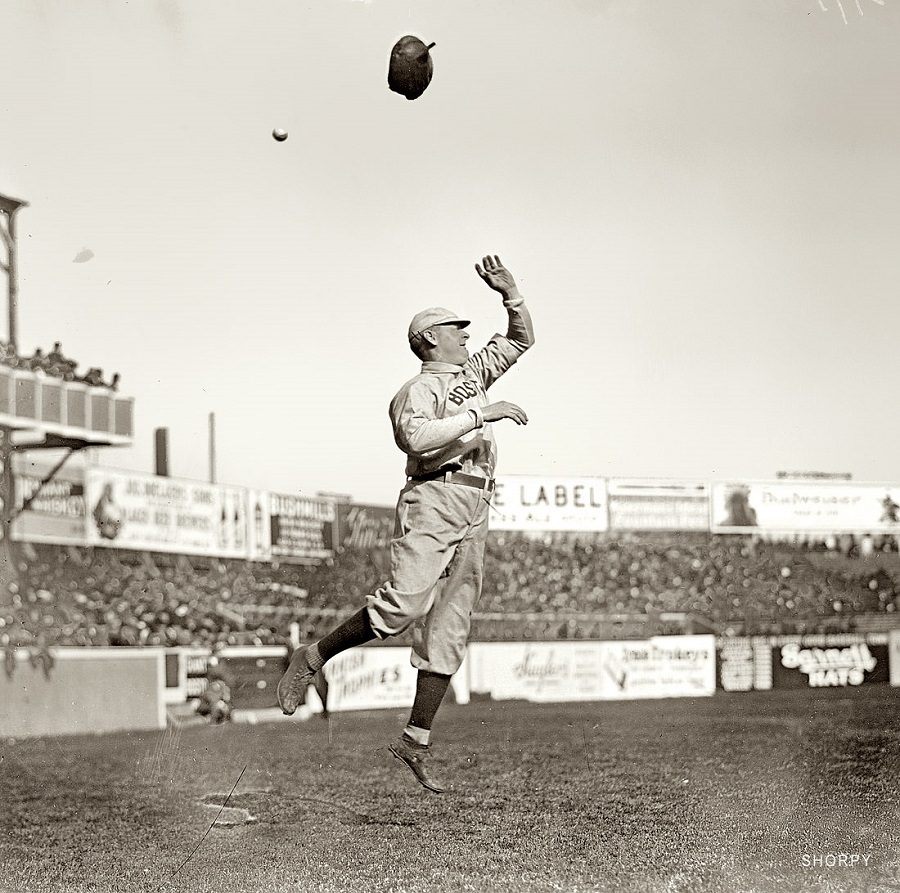
Mid-leap on the ballfield, Boston Nationals (later known as the Braves) manager Fred Lake reaches skyward as a glove spins loose above him and the ball hangs nearby, a split second from impact. The photographer freezes the awkward, athletic scramble implied by the title—“does it the hard way”—capturing a moment when control is uncertain and instinct takes over. In his Boston uniform, Lake becomes both subject and symbol of early baseball’s rough-edged grace.
Behind the action, the packed grandstand and a long ribbon of outfield advertising set the scene in the language of 1910: crowds pressed close, signage dominating the horizon, and the open air of a big-league park. The composition emphasizes distance and height, giving the sky as much importance as the player, while the raised hand and drifting glove telegraph the drama without needing any caption. Even without a scoreboard in view, the atmosphere reads as a busy game day in a thriving baseball city.
Baseball history often lives in posed portraits and team rows, but this kind of candid sports photography brings the dead-ball era to life with immediacy. Lake’s airborne reach, the tumbling equipment, and the sea of spectators make an unforgettable vignette for anyone searching for Boston Braves history, early MLB imagery, or rare 1910 baseball photos. It’s a reminder that managers then weren’t distant strategists—they could be right in the thick of it, taking the play personally.