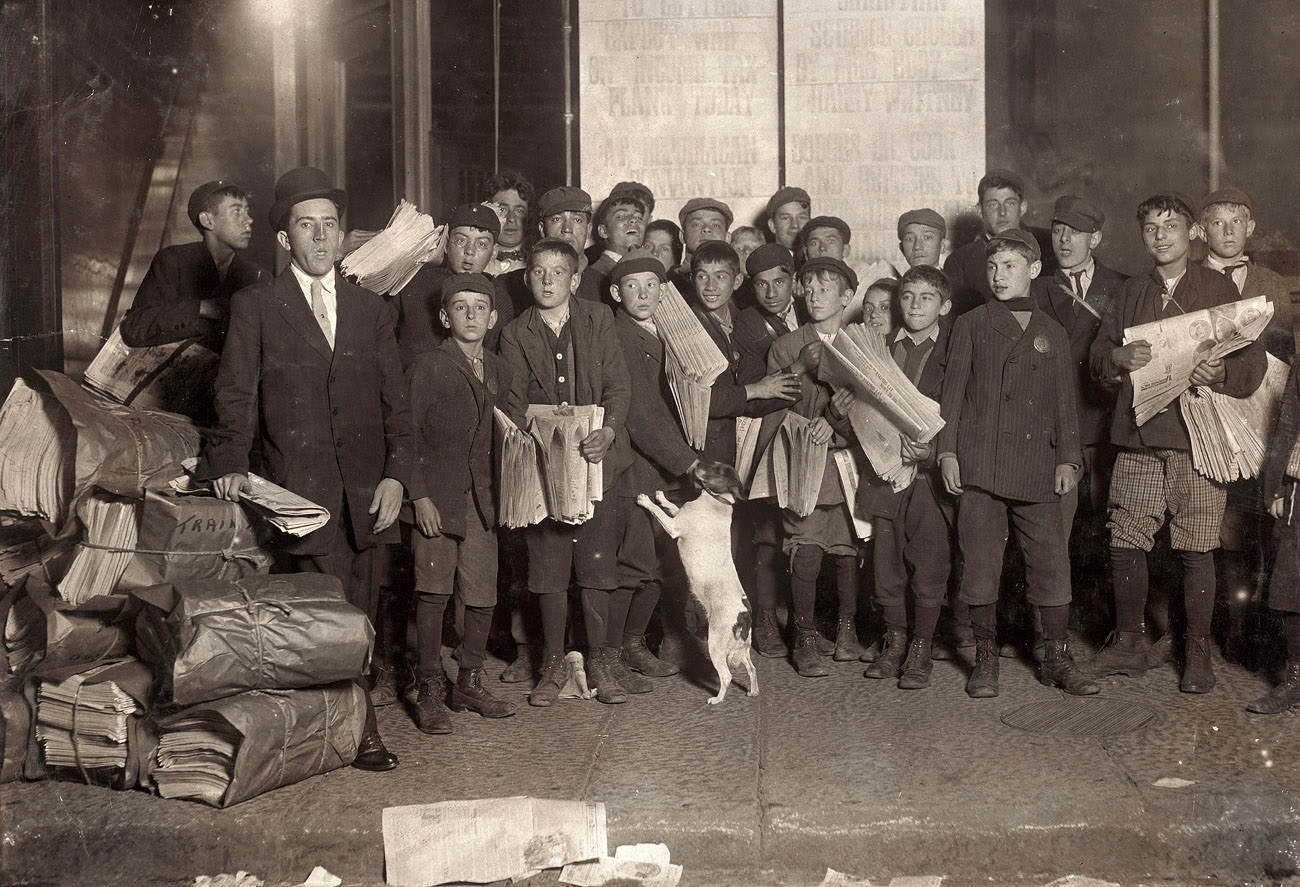
Sunday at 5 a.m. finds a crowd of Boston newsies gathered at the edge of the street, arms loaded with thick bundles of papers and pockets ready for change. Caps and knee-length trousers, sturdy boots, and rumpled jackets signal a working world that starts long before most households stir. A man in a dark suit and hat stands among them, while stacks of wrapped newspapers rise at the left like cargo waiting to be moved into the city.
Faces turn toward the camera in a mix of curiosity and fatigue, the kind that comes from early hours and hard routines. Several boys clutch multiple editions at once, gripping their stock the way shopkeepers might hold inventory, and a small dog leaps up in the foreground, adding a flash of motion to the posed group. Behind them, the dim backdrop and broad posted notices hint at the storefronts and transit corridors where these young sellers would fan out to meet the morning crowds.
The title’s details—Boston, Massachusetts, 1909—place the scene in an era when street journalism was part of urban life and the Sunday paper was a major event. Newsboys did more than hawk headlines; they formed a network that carried information block by block, shaping how neighborhoods learned about the wider world. For anyone searching local history, child labor in early twentieth-century America, or the everyday texture of Boston streets, this photograph offers a vivid starting point.