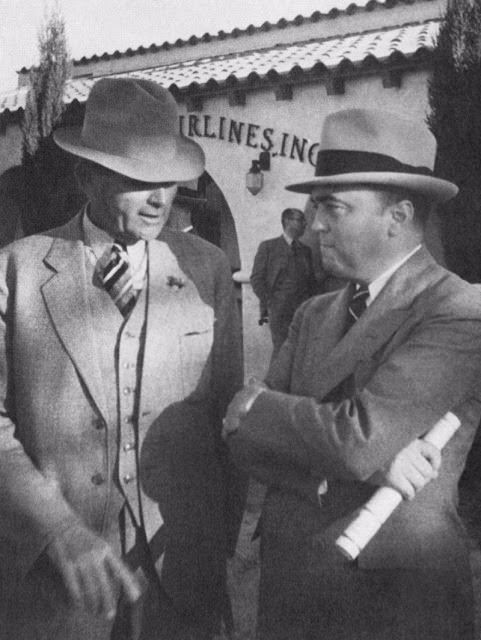
Two sharply dressed lawmen stand in conversation outside a stucco building, their hats and tailored coats signaling authority as clearly as any badge. On the right is FBI chief J. Edgar Hoover, arms folded and a rolled document tucked under one elbow, projecting a careful, administrative confidence. Facing him is Tom White, identified in the title as a stetson-wearing Texan, whose broader brim and frontier-leaning style hint at a different kind of experience—fieldwork, hard travel, and direct pursuit.
The setting adds texture: Spanish-style roof tiles, bright daylight, and a partially readable sign behind them that suggests a public place rather than a private office. A bystander lingers in the background, reinforcing the sense that this meeting happened in the open, where official business brushes up against everyday life. Even without hearing their words, the body language reads like a briefing—strategy being weighed, responsibilities being handed off, and reputations riding on the outcome.
As a piece of American crime and law-enforcement history, the photograph speaks to the moment when federal power and regional know-how were deliberately paired to solve a high-stakes case. It frames Hoover not just as a distant bureaucrat but as a man who recruited specific talent, while Tom White appears as the practical specialist brought in to deliver results. For readers searching for J. Edgar Hoover photos, Tom White images, or early FBI investigative history, the scene offers a compelling snapshot of leadership, collaboration, and the evolving public image of the Bureau.