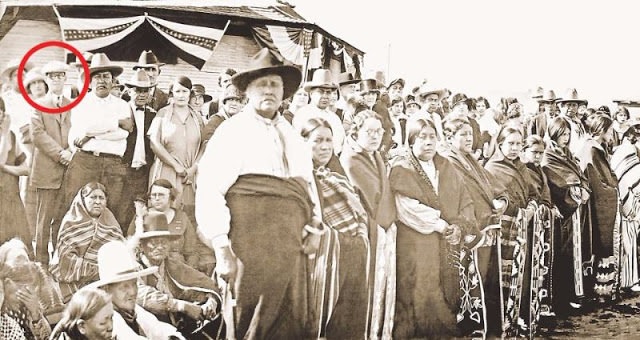
Beneath a striped canopy and a line of watchful faces, the Osage community stands arranged for what was meant to be a sweeping panoramic portrait—part ceremony, part record, part public display. Blankets, hats, and layered clothing form a dense texture across the frame, with seated figures in the foreground and a tightly packed crowd stretching out of view, hinting at the larger photograph this segment once belonged to.
A red circle pulls the eye toward a man at the far left, a deliberate mark that turns an ordinary group photo into evidence and warning. The post title, “Devil in the detail,” speaks to how easily a single presence can alter the meaning of an image, and how later hands—editors, archivists, or interested parties—could literally cut away uncomfortable context by removing a section of the panorama.
What remains is a striking artifact of Osage history and the fraught world surrounding it, where public appearances, powerful outsiders, and the politics of representation collided. For readers searching for a 1924 Osage tribe panorama, this cropped portion invites closer looking: not only at the people assembled, but at what was excised, what was emphasized, and how memory can be shaped as much by subtraction as by the camera itself.