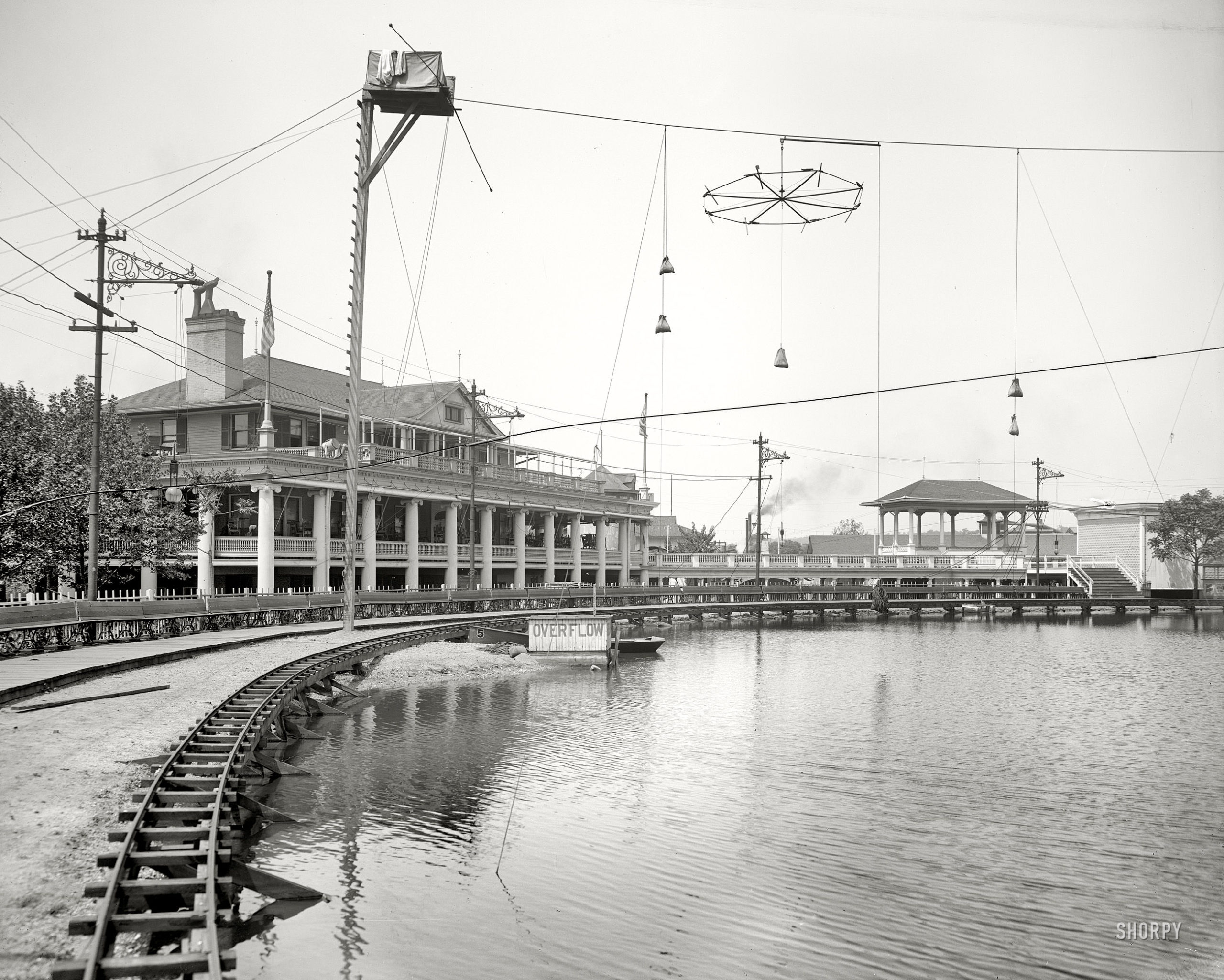
Along the edge of Chester Park’s lake in Cincinnati, the clubhouse stretches wide with deep porches, rows of columns, and flags lifted above the roofline. A narrow track curves tightly along the shoreline, guiding the eye toward the water and the long pier that stitches together buildings and boardwalk. The scene feels carefully arranged for leisure, yet it also hints at the practical infrastructure—fences, posts, and walkways—that kept this popular destination running smoothly.
Overhead, a web of wires and suspended fixtures hangs across the open sky, lending the view an unmistakably early-1900s character. The calm surface of the lake reflects the park’s structures in soft ripples, while the sign marked “OVERFLOW” near the waterline reminds us that even picturesque urban lakes demanded constant attention. Details like the pavilion in the distance and the stepped landing on the right suggest multiple gathering points, as if the shoreline was designed for strolling, watching, and arriving by foot.
For anyone searching Cincinnati history or Chester Park memorabilia, this circa-1906 photograph offers a rich look at how recreation, architecture, and technology met at the water’s edge. The clubhouse reads as both social hub and scenic backdrop, anchoring an environment built for crowds and summer evenings. Taken together—lake, pier, track, and skyline of wires—the image preserves a moment when an amusement park landscape was as much about engineered spectacle as it was about escaping the city’s pace.