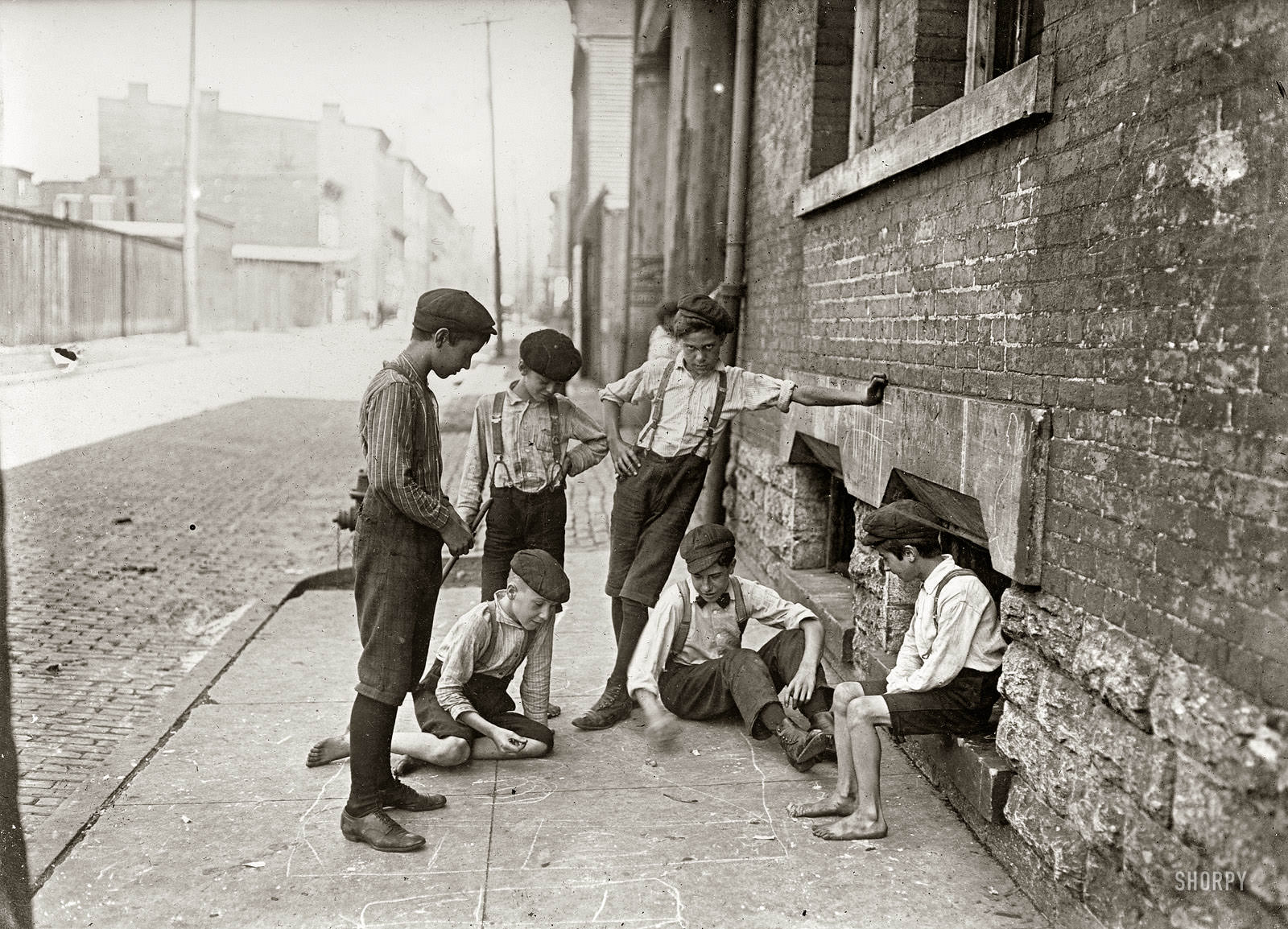
Along a Cincinnati sidewalk in August 1908, a handful of boys turn a narrow strip of pavement into their own gaming table, crouching close to the ground where chalk lines and small marks define the “board.” Flat caps, suspenders, rolled sleeves, and bare feet set the scene firmly in the working-class street life of early twentieth-century Ohio, where play and risk could unfold in plain view. The brick wall beside them—scarred, patched, and textured—frames the moment like a stage set, while the quiet street beyond recedes into industrial haze.
Attention gathers around the throw: one boy leans in with intent, another stands back to watch, and a third props himself against the wall with an attitude that suggests both confidence and impatience. The chalked rectangles on the sidewalk hint at rules learned by doing, passed hand to hand rather than written down, and the small circle of spectators shows how quickly a street corner could become a social arena. Even without hearing the talk, you can almost sense the rhythm—anticipation, the clatter of dice, then the quick recalculation of fortunes.
For anyone searching for historic Cincinnati photos, early 1900s street scenes, or the everyday story of gambling games like craps in America, this image offers a vivid glimpse into informal recreation outside the parlor and away from official leisure spaces. It also quietly documents the built environment—cobblestones, curb, stoop-like openings, and worn masonry—capturing the texture of urban life as much as the children at play. “Places & People” fits perfectly here: a small human drama unfolding in a real, weathered place, preserved for later generations to read between the lines.