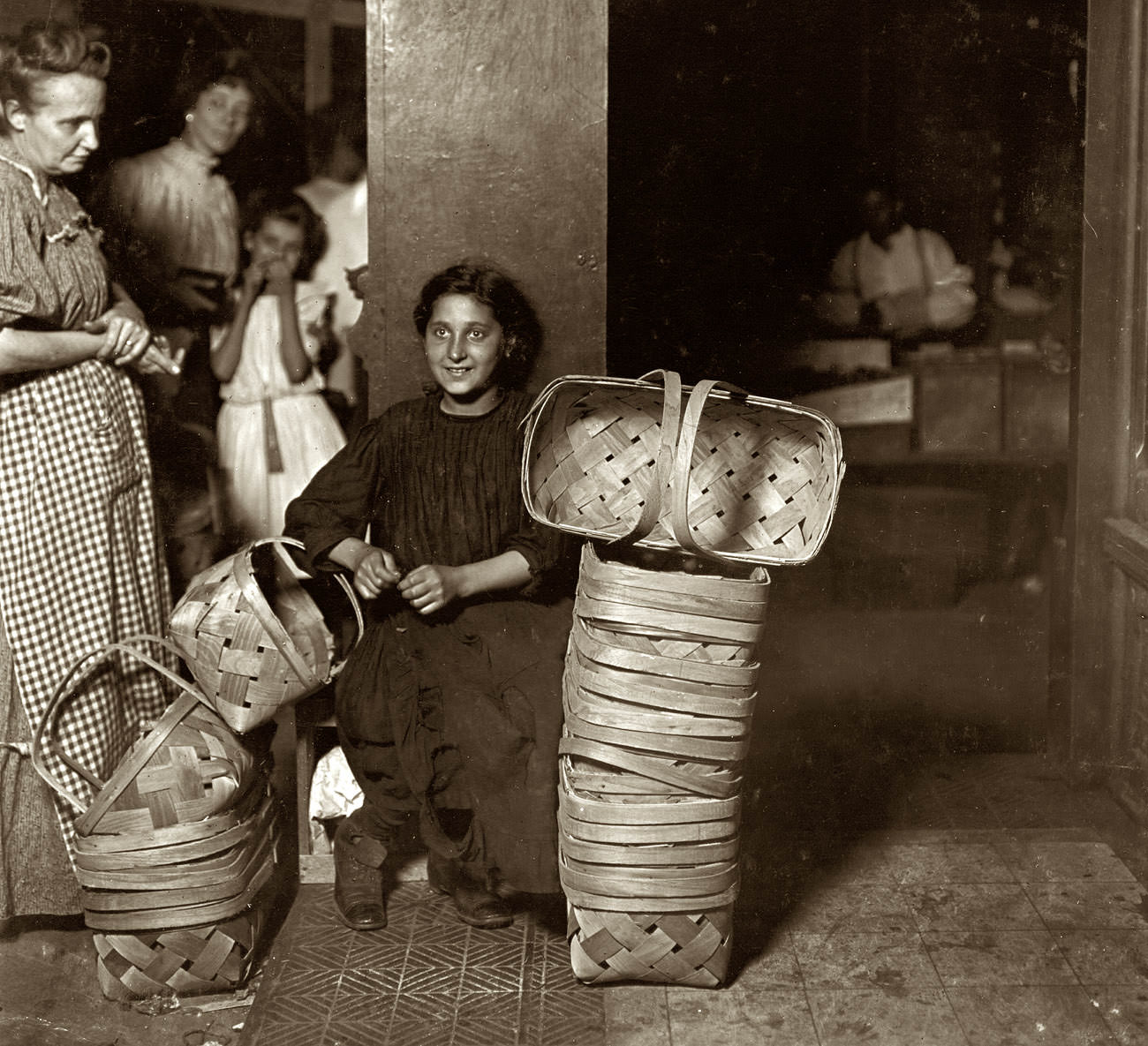
Eleven-year-old Lena Lochiavo sits near a thick market post, framed by a small mountain of woven baskets that nearly rivals her in height. The baskets—stacked, nested, and strapped—create a textured foreground of split wood and braided handles, while Lena’s steady gaze and slight smile pull the viewer in. Around her, adults and a child linger at the edge of the scene, their faces half-lit and watchful, suggesting a busy public space where work and everyday life overlap.
At Cincinnati’s Sixth Street Market in August 1908, selling baskets was more than a simple errand; it was a way families turned handcraft and hustle into daily income. The photograph hints at the market’s rhythm: customers drifting past, vendors stationed in doorways, and goods arranged to catch the eye. Even without hearing the bargaining or footsteps, the dim interior and worn floor tiles evoke a well-used commercial corridor, the kind that anchored city neighborhoods long before supermarkets and chain stores.
Details like Lena’s dark dress, sturdy shoes, and the practical bundling of the baskets speak to the realities of child labor and street vending in early 20th-century America. Yet the scene also preserves a human moment—poised between duty and childhood—set against the backdrop of an immigrant-rich, working-class city economy. For readers searching Cincinnati history, Sixth Street Market lore, or the social history of 1908, this image offers a vivid window into places and people that built the urban marketplace one transaction at a time.