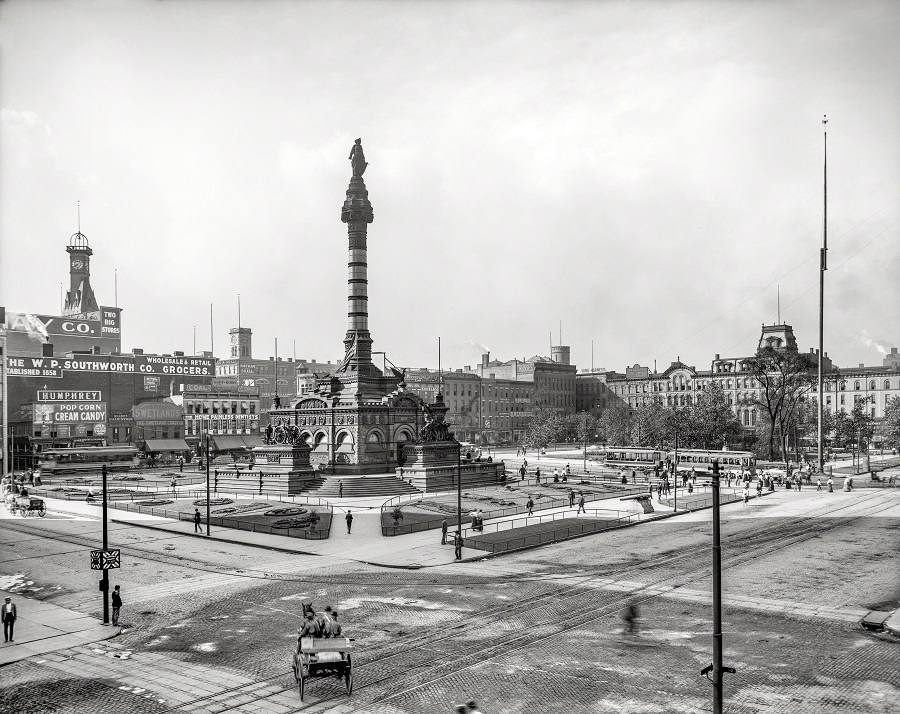
Rising from the heart of Public Square, Cleveland’s Soldiers and Sailors Monument dominates the scene with its tall column and sculptural base, a clear focal point for the city around 1900. The monument’s stonework and statuary stand in sharp contrast to the open sky, while pedestrians move along the surrounding walks as if the memorial has already become an everyday landmark. Streetcar tracks curve and intersect at the edges of the square, hinting at how thoroughly transit shaped downtown life.
Along the perimeter, storefronts and commercial blocks press close, their facades punctuated by bold painted signs and rooftop advertising that turn the streetscape into a collage of early urban marketing. A clock tower and varied rooflines suggest a busy civic and business district, where people could navigate by familiar silhouettes as much as by street names. The mix of ornate architecture and utilitarian signage captures a Cleveland that is modernizing quickly, yet still textured with nineteenth-century design.
Movement is everywhere: streetcars line up near the curb, a horse-drawn wagon passes through the foreground, and small groups cross the broad roadway worn by wheels and rails. The photograph offers more than a view of a famous monument in Cleveland, Ohio—it reads as a snapshot of how public memory, commerce, and transportation met in one shared space. For anyone searching local history or Public Square’s past, it preserves the monument not as an isolated memorial, but as the center of a living city.