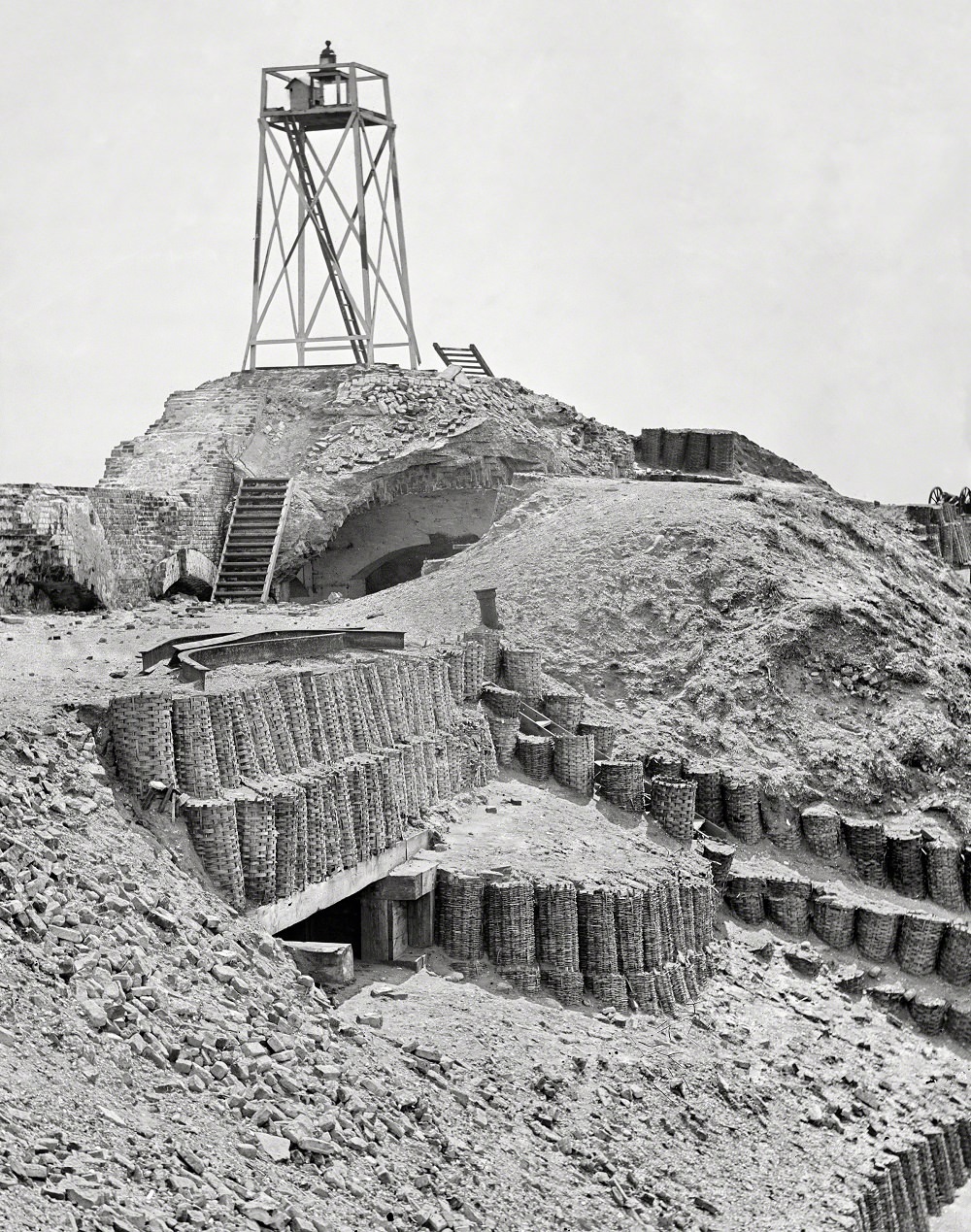
High above the broken brickwork of Fort Sumter, a stark beacon rises on a spindly wooden frame, its lantern housing perched like a watchful eye over Charleston Harbor. The parapet beneath it is no smooth wall but a jagged ridge of debris, with makeshift ladders leaning into the ruin and stepped paths cut into the wreckage. In 1865, that contrast—navigation light above, shattered masonry below—speaks quietly of a place shifting from battlefield to shoreline landmark.
Looking closer, the ground tells its own story in textures: heaps of fallen bricks, scoured sand, and a curving line of woven gabions or baskets stacked as protective revetments. Arched openings and partially buried chambers hint at the fort’s interior spaces, now exposed by bombardment and collapse. The scene feels engineered and improvised at once, capturing how military structures were patched, stabilized, and repurposed even as their original forms were being erased.
For anyone searching Civil War photography, Fort Sumter ruins, or Charleston 1865, this view offers a striking study in aftermath rather than action. The beacon on the parapet suggests renewed attention to the harbor’s practical needs—safe passage, visibility, and order—while the torn landscape preserves the fort’s hard-won history in plain sight. It’s a powerful reminder that the end of conflict is often written in reconstruction, one ladder, timber frame, and piled brick at a time.