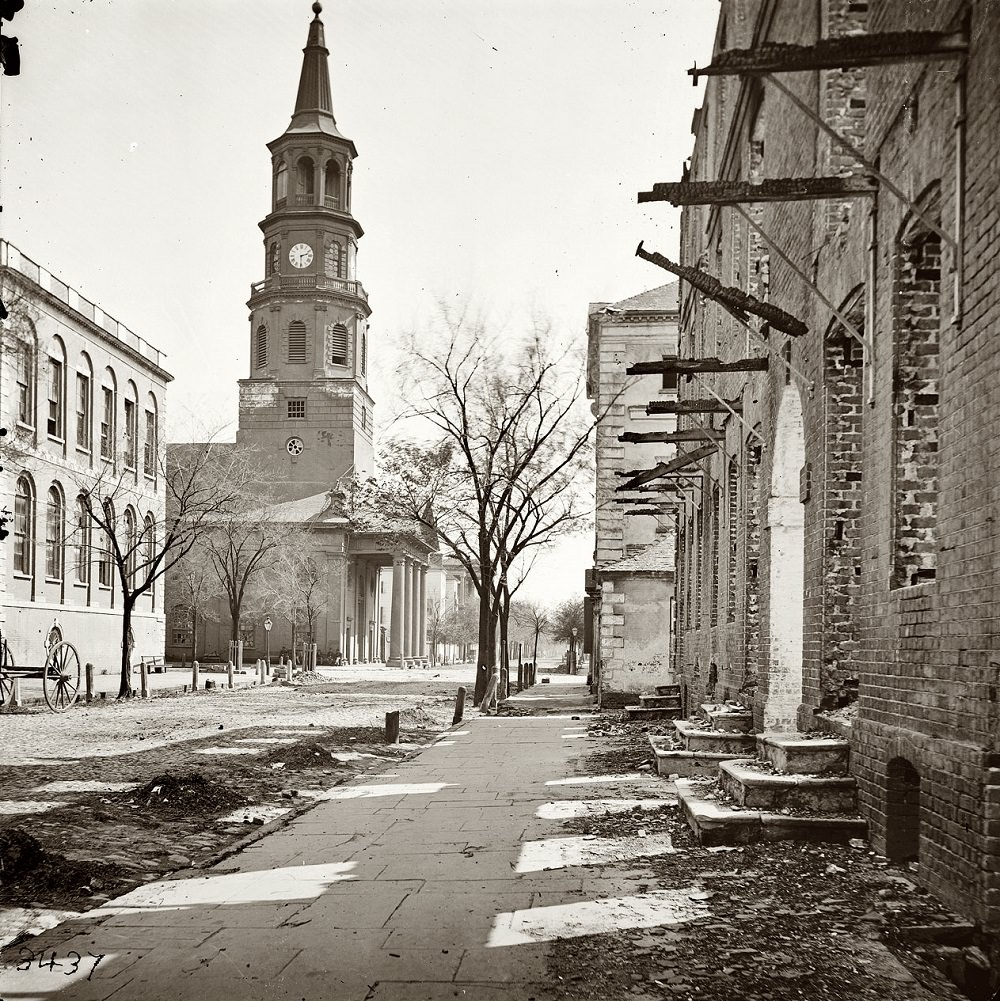
Rising above a quiet Charleston street, the steeple and clock of St. Michael’s Episcopal Church anchor the scene, its classical portico and tall tiers drawing the eye down the long perspective of pavement and winter-bare trees. The wide roadway looks rough and rutted beside the orderly sidewalk, and the sparse activity makes the church’s presence feel even more monumental. For anyone searching historic Charleston photography, this view offers a clear sense of scale and streetscape around one of the city’s most recognizable landmarks.
Along the right edge, the brick façade tells another story: broken openings, scattered rubble, and rows of projecting ironwork where structures once extended outward. The contrast between the sturdy church tower and the damaged wall creates a powerful visual record of an urban center under strain, captured with the matter-of-fact clarity typical of mid-19th-century documentation. Details like the uneven masonry and debris at the stoops invite a closer look at what daily passage through this block may have been like.
Set in 1865, the photograph reads as both architecture study and historical testimony, linking St. Michael’s Episcopal Church to a Charleston in transition. The composition frames the sanctuary not in isolation, but as part of a lived-in corridor of warehouses, civic buildings, and street life reduced to essentials. As a “Places & People” post, it’s a compelling reminder that even when few figures appear, the city’s buildings carry the marks of the people and events that shaped them.